Part II
Chapter 14: Scientific Pathways
Estimated reading time: 14 min
“The most beautiful thing we can experience is the mysterious. It is the source of all true art and science.”
— Albert Einstein
After the Firmament has entered breath, relation, and choice, return to the observatory and test each bridge without closing the mystery it crosses.
Imagine two vast libraries in different wings of an old observatory. One holds number, proof, and hidden symmetry. The other holds wave, vibration, and the music of form. For centuries they seem to speak different tongues. Then a quiet intuition arises: perhaps the deepest relations in one chamber can be translated into the other without losing what matters.
The same intuition moves through the Firmament. Biology and myth, quantum field and contemplative silence, neuron and archetype speak in unlike vocabularies, yet sometimes carry a similar pattern of relation, limit, or emergence across the bridge.
The observatory opens into a final gallery, where four scientific pathways cast their own light on the Four Pillars.
Let Each Language Keep Its Law
Science supplies models and measurements; myth and contemplation bring images and lived recognition. Each can illuminate what another leaves unseen.
I. Interconnectedness: The Physics of Relationship
Quantum Entanglement: Non-Classical Correlations
Entanglement means two or more particles share a joint quantum state, so their measurement outcomes can correlate even across distance. Experiments repeatedly violate Bell-type inequalities, which is why the puzzle is not poetic flourish but measured non-classical correlation. Yet the correlation is not a signal or force passing between particles, and entanglement cannot carry faster-than-light messages.
Networks and Graphs: The Topology of Relationship
Network science distinguishes small-world networks, where most nodes are separated by only a few steps, from scale-free models, whose degree distribution follows a power law and leaves a few highly connected hubs. Topology changes how quickly effects spread and where a network is robust or fragile.
Category and Duality: Bridging Forms Without Collisions
In mathematics and physics, a duality means two very different descriptions can still preserve the same structure. One language may speak in geometry, another in algebra or fields, yet the translation can keep the invariant relations intact.
This is not the philosophical use of duality as a split. Inside mathematics and physics, it can name a disciplined equivalence between descriptions. Category theory sharpens the point by paying close attention to relationships between things, not just the things themselves.
The Langlands Program: Grand Correspondence
In modern mathematics, the Langlands Program is a web of conjectures and theorems linking arithmetic and number theory with automorphic forms, harmonic analysis, and representation theory. It seeks precise correspondences among structures that can look unrelated without making them the same object.
Imagine arithmetic discovering an unexpected music: different mathematical languages carrying linked structure across surprising distance.
Once that kinship is felt, the human analogue becomes easier to recognize: a recurring contour may appear as theorem in one chamber, mythic image in another, and contemplative recognition in a third.
Human life poses a similar problem. Biological, somatic, and mythic languages are too often treated as separate universes. Biology names amygdala, hormones, neurotransmitters, medications, and shifting thresholds; lived language names fear, numbness, guarded composure, or longing; myth names Serpent, devotion, descent, or return. Each can keep faith with the same lived pressure.
Chemistry does not exhaust a life, but it is one of the clearest places where science and spirit touch lived experience. Hormones, neurotransmitters, medications, and state-altering catalysts can shift threshold, tempo, salience, and contact before story catches up. Mechanism names one layer of the event. Myth helps us read another.
II. Dynamic Emergence: The Physics of Becoming
The Quantum Vacuum: A Ground of Latent Potential
In quantum field theory, fields permeate spacetime and still fluctuate in their lowest-energy state. “Emptiness” depends on boundaries and conditions; the vacuum is a context-sensitive physical state rather than simple nothingness. Even measurable effects such as the Casimir effect remind us that what looks empty can still behave as a structured field.
The Quantum Vacuum is physical, not the Void. As metaphor, it evokes depth from which form appears and into which it dissolves.
Symmetry and Symmetry-Breaking: How Pattern Becomes Particular
Many physical laws are symmetric: they look the same under certain transformations (like rotations). When conditions change (cooling, constraints, interactions), those symmetries can break and distinct structures emerge—crystals form, forces differentiate, patterns appear.
Emergence can be felt as life moving from undivided possibility to specific commitments. Saying “yes” here necessarily says “not that”—a creative narrowing that makes meaning.
Chaos and Complexity: Pattern Without Predictability
Chaotic systems are deterministic yet sensitively dependent on initial conditions, so tiny differences can produce divergent trajectories; their motion may still organize around attractors. Complexity science studies how interactions among many parts generate coherent patterns without a central controller. Together they show how unpredictability and order can coexist, and why some systems generate novelty near transitions between rigidity and turbulence.
Dissipative Structures: Organization Far from Equilibrium
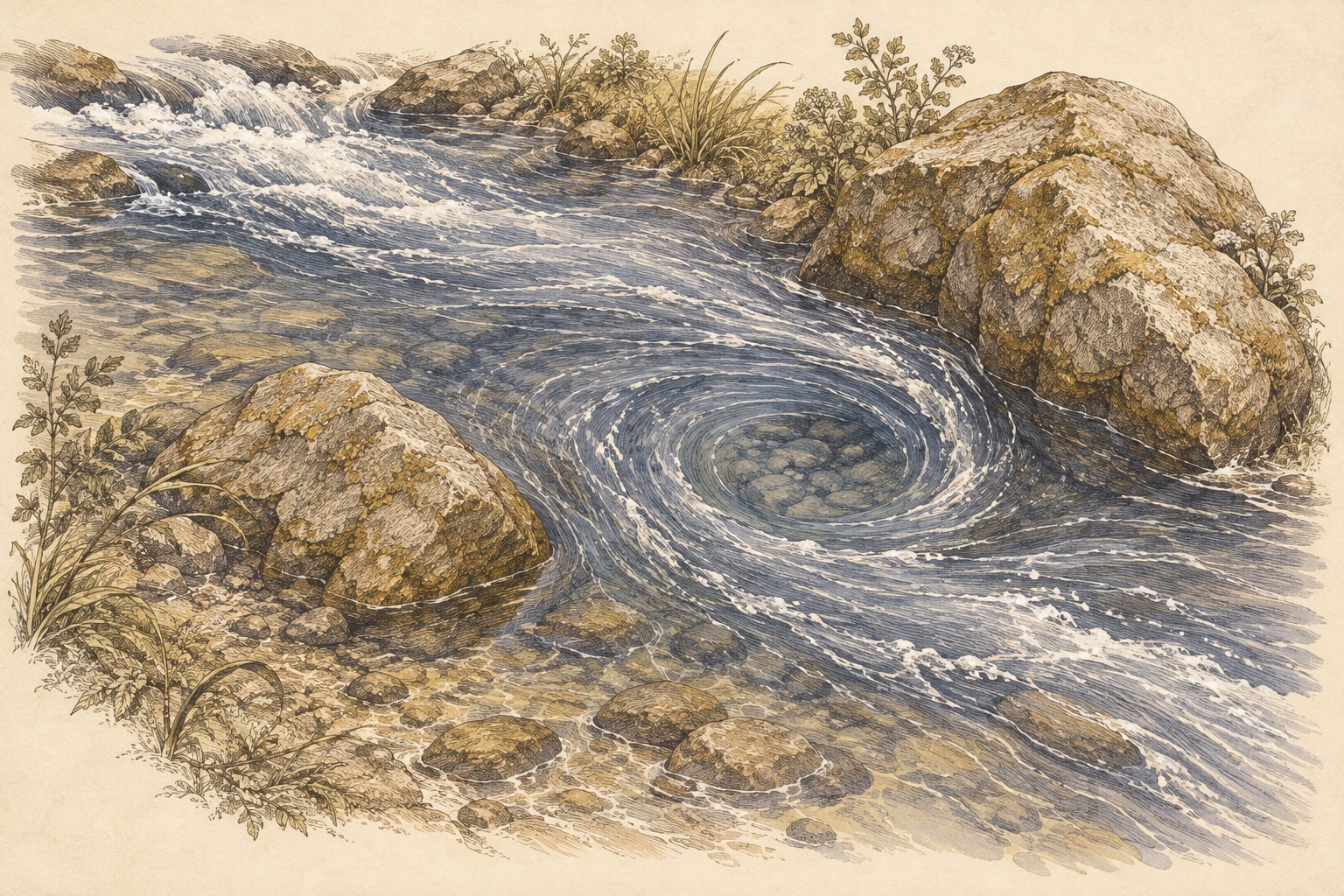
In non-equilibrium thermodynamics, Ilya Prigogine’s work on dissipative structures1 describes organized patterns that can only exist by taking in energy and exporting entropy into their environment, often through heat flows—like a whirlpool, a flame, or a living cell.
When energy flow or another control parameter crosses a threshold, a far-from-equilibrium system can lose stability. At a bifurcation, different trajectories become available: another organized regime may appear, while other paths lose coherence. Instability does not choose the outcome.
At the human scale, this becomes a potent image of the crucible through which the Serpent can become Dragon’s Fire. When intense life force, grief, or trauma floods the nervous system, the old organization of self may not be able to hold the voltage. It can feel like you are breaking.
Destabilization is not the medicine. It becomes workable only when enough support, time, and containment allow reorganization rather than collapse. Healing need not restore the “old calm.” It can reorganize life into wider, steadier capacity—one able to hold charge with greater ethical responsibility, choice, and contact.
Renormalization and Scale: Patterns That Survive Zooming
Renormalization asks what changes and what stays true as you zoom in or out on a system. Some features only make sense at one scale; others survive the zoom. Think of refocusing your eyes so the forest and the trees both stay legible without losing the shape of the whole. A fixed point is the special case in which changing scale leaves the theory unchanged, once quantities are expressed in the new units.2
At the human scale, the image becomes a question: what stays recognizable as circumstances change? Kept agreements, honest signalling, and clear boundaries can stabilize integrity from ordinary choices to crisis.
Fractal Hints: Self-Similarity Without Sameness
Here the Spiral Path becomes a Fractal Spiral Path: each threshold contains smaller thresholds and sits within larger ones. The same knot can recur across body, psyche, relationship, lineage, and world. The path rhymes across scale without merely repeating.
III. Participatory Reality: Observation, Choice, and Models
Uncertainty and Context-Dependence
In quantum physics, certain pairs of observables, such as position and momentum, cannot both have arbitrarily sharp distributions in the same quantum state. The limit belongs to the formalism, not merely to imperfect instruments. A specified measurement yields one of its possible outcomes according to probabilities encoded by the quantum state. What that state represents before the outcome—and whether any physical collapse occurs—depends on the interpretation.3
As an analogy, this invites humility about certainty. It honours how setting, relationship, and attention shape what “shows up.”
Quantum Interpretations and Collapse Models: Holding Multiple Accounts
Competing interpretations—Copenhagen, Many-Worlds, Bohmian, and QBism among them—differ on how outcomes arise and what a quantum state means. Objective-collapse models instead modify quantum dynamics and make testable physical predictions; they are not merely interpretations of unchanged formalism.4
The coexistence of empirically constrained but conceptually different accounts resembles one facet of Participatory Reality: observation and interaction matter in some views, while more than one serious account can remain live. Every account remains answerable to experiment; no story is licensed to absorb every result.
Wheeler’s Participatory Universe: It from Bit and the Self-Observing Universe
Theoretical physicist John Archibald Wheeler proposed a “participatory universe”:5 not a finished stage we merely witness, but a cosmos whose describable reality is braided with the questions, measurements, and records through which it is known.
His phrase it from bit names this intuition: that the physical “it” cannot be fully separated from the informational distinctions, the “bits,” by which it becomes definite.
Wheeler sketched this as a great “U” of the universe with an eye at one end, looking back toward its own origin. It becomes a kind of cosmic self-portrait: the cosmos, through observers, witnessing itself.
This is one of the most direct bridges from cosmology to lived participation. You are not a separate ego looking at a cold world. You are a local expression of the Entangled Firmament looking back into the field that formed you.
On a human scale, the image invites participation within conditions you never fully stand outside, loosening the fantasy of mastery over reality.
Game Dynamics and Equilibria: Strategy in Living Systems
In game theory, a Nash equilibrium is a strategy profile in which no player can benefit by changing strategy unilaterally. It can be cooperative or exploitative: stable does not mean good. An equilibrium may shift when payoffs or available strategies change.
Relationships and communities settle into patterns just as systems do. The participatory edge is salience: what each person expects in the room changes which choices feel available. If candour is punished and the mask earns approval, distortion stabilizes. If reciprocity and honest signals become easier to sustain, more coherent forms of cooperation become possible.
Measurement, Usefulness, and Humility
Across sciences, models earn trust inside their domains and grow thin outside them.
The Entangled Firmament asks for the same discipline. The useful description is the one that clarifies the moment; no single language gets to erase the rest.
IV. Bounded Infinity: Depth Inside Limits
Information and Boundaries: What Differences Make a Difference
In Shannon’s information theory, information means measurable distinctions moving through limited channels, with noise and capacity shaping reliability; it does not by itself supply semantic meaning. Landauer’s principle adds a narrower physical result: logically irreversible information erasure has a minimum thermodynamic cost under defined conditions.
As an analogy, attention behaves like a limited channel. When too much arrives at once, distinctions become harder to track. A conversation shows the same constraint: interruption, threat, or speed can overwhelm what either person can receive; enough pacing and structure let meaning survive the crossing.
Autopoiesis: The Living Boundary
Coined by biologists Humberto Maturana and Francisco Varela, autopoiesis6 (self-creation) describes a self-producing network: its processes continually generate the components that regenerate the network and constitute the living unity, including its boundary.
A cell’s membrane is semi-permeable: it must let nutrients in and waste out while keeping the organism intact. If the membrane becomes too rigid, the cell starves. If it dissolves, the cell vanishes into the environment.
At the human scale, the same image frames one face of Bounded Infinity: a finite living boundary becomes an aperture through which greater depth can take local form. It keeps enough contour for exchange without hardening into isolation or dissolving into the room; it does not contain or exhaust the infinity it renders.
Holography: Boundaries, Interference, and Reconstruction
At its most concrete, holography begins as an optical act. Coherent beams meet, a bounded plate records their interference, and later the right light can reconstruct an image from that distributed trace. The pattern spans the plate rather than occupying one privileged point.
Ideas from black hole thermodynamics and quantum gravity (especially string theory) give this image a boundary charge: the information inside a region may be encoded on its edge. One reason this became compelling is that black hole entropy scales with horizon area rather than enclosed volume.
In plain language, a bounded edge can carry enough structure for reconstruction. In human terms, a boundary makes the conditions of contact visible: what can cross, what cannot, and what form must be preserved.
Memory and perception give the holographic image a different human-scale bridge.7 Dennis Gabor’s 1968 model of temporal recall and Karl H. Pribram’s later holonomic brain work both treated holography as a way to think about distributed memory and retrieval. Here the structure matters: recall may move through a system rather than sit as one object stored in one place.
Gabor’s earlier time-frequency functions add a more mathematical bridge. Their localized wave mathematics influenced signal analysis.8 Later work found that simple-cell receptive fields in visual cortex can often be approximated by two-dimensional Gabor filters.9 In that narrower sense, the bridge to perception runs through filtering, locality, and reconstruction.
The boundary matters: this bridge does not prove consciousness is a literal hologram, nor does it prove that neurons compute by sustained quantum coherence. Neural function rests on molecular and ionic events whose chemistry is quantum at bottom. Action potentials and cortical signalling, however, are usually modelled at the cellular scale through classical electrophysiology, stochastic ion-channel dynamics, and rapid decoherence.10
Localized wave mathematics, distributed pattern storage, and neural filtering help imagine how a fragment can carry enough structured trace for meaning to be reconstructed.

Black Hole Physics: Metaphors at Spacetime’s Edge
Black holes test our theories and offer potent images for inner thresholds. A black hole is a region where gravity is so strong that nothing, not even light, escapes once it crosses the event horizon. The edge is physically severe and theoretically strange: time, information, and description all come under pressure there.
To distant observers, infalling objects appear to slow near the horizon. In many common explanations of sufficiently large black holes, horizon crossing is locally uneventful for the falling object, at least before tidal forces become severe—while still irreversible.
A black hole’s event horizon is a one-way threshold, like a choice you cannot uncross. Once crossed, the grinding friction of “should I?” can stop; the work becomes care for the shape now chosen. From the outside it can look frozen; from the inside it is already done, like a relationship decision that reads as hesitation to onlookers while, within you, it has already resolved.
Quantum theory makes the edge stranger still: Hawking radiation and the information problem mean black holes are not just places where matter vanishes. The harder question is where the pattern goes, how it is encoded, and whether apparent loss is loss at all.
Let it stand as an image for irreversible commitments and the care they require.
Positive Geometry: Infinite Richness Inside Real Limits
In a highly symmetric theory of particle interactions, positive geometry uses mathematical shapes to construct some of the ingredients for calculating how particles scatter.11 Exact constraints organize a rich mathematical object.
Form does not merely restrict depth. It can concentrate it. A rigorous edge can become the very condition under which richness appears.
Mathematics abounds with structures whose exact constraints still permit extraordinary depth: Cantor-like sets generated through endless subdivision and removal, space-filling curves that overturn intuition about dimension, and infinite-dimensional Hilbert spaces disciplined by norms. The lesson is simple: strict form does not extinguish vastness; it gives it somewhere to appear.
Your life is a finite horizon with unending depth. Constraints (body, time, vows) do not choke possibility. They shape it, concentrating the field so meaning can condense.
Let the Wonder Stay Honest
The sky does not disappear here. It moves inward, where hidden shapes begin to show their faces.
The bridge now turns intimate: not equations or formal systems, but the recurring faces by which these forces enter fear, longing, conflict, devotion, and choice.
For an early formulation, see Ilya Prigogine, Dissipative Structures, Dynamics and Entropy (1975).↩︎
A renormalization-group (RG) fixed point is a point in theory space left unchanged by the RG transformation: dimensionless couplings stop flowing and their beta functions vanish. See Kenneth G. Wilson and J. Kogut, The renormalization group and the ε expansion, Physics Reports 12(2), 75–199 (1974). For an accessible statement of the fixed-point condition, see Alex Kovner, Introduction to Renormalization Group, pp. 15, 29 (2013).↩︎
See Maximilian Schlosshauer, Decoherence, the measurement problem, and interpretations of quantum mechanics, Reviews of Modern Physics 76, 1267–1305 (2005).↩︎
See Angelo Bassi et al., Models of wave-function collapse, underlying theories, and experimental tests, Reviews of Modern Physics 85, 471–527 (2013).↩︎
For Wheeler’s participatory-universe language, see the archival record for This participatory universe (1981) at the American Philosophical Society, and John Archibald Wheeler, Information, physics, quantum: the search for links (1989).↩︎
For the original framework, see Humberto R. Maturana and Francisco J. Varela, Autopoiesis and Cognition: The Realization of the Living (1980).↩︎
See Dennis Gabor, Holographic Model of Temporal Recall, Nature 217, 584 (1968); Karl H. Pribram, Languages of the Brain: Experimental Paradoxes and Principles in Neuropsychology (1971); and Karl H. Pribram, M. Nuwer, and R. J. Baron, The holographic hypothesis of memory structure in brain function and perception (1973).↩︎
For Gabor’s time-frequency analysis, see Dennis Gabor, Theory of communication, Journal of the Institution of Electrical Engineers — Part III 93(26), 429–441 (1946).↩︎
For visual receptive fields and Gabor filters, see John G. Daugman, Uncertainty relation for resolution in space, spatial frequency, and orientation optimized by two-dimensional visual cortical filters, Journal of the Optical Society of America A 2(7), 1160–1169 (1985), and J. P. Jones and L. A. Palmer, An evaluation of the two-dimensional Gabor filter model of simple receptive fields in cat striate cortex, Journal of Neurophysiology 58(6), 1233–1258 (1987).↩︎
For the decoherence guardrail, see Max Tegmark, The importance of quantum decoherence in brain processes, Physical Review E 61, 4194–4206 (2000).↩︎
For a construction of one-loop scattering-amplitude integrands in planar N=4 super-Yang–Mills theory, see Livia Ferro, Ross Glew, Tomasz Łukowski, et al., Prescriptive unitarity from positive geometries (2024).↩︎