Part IV
Chapter 21: Structure and Flow
Estimated reading time: 6 min
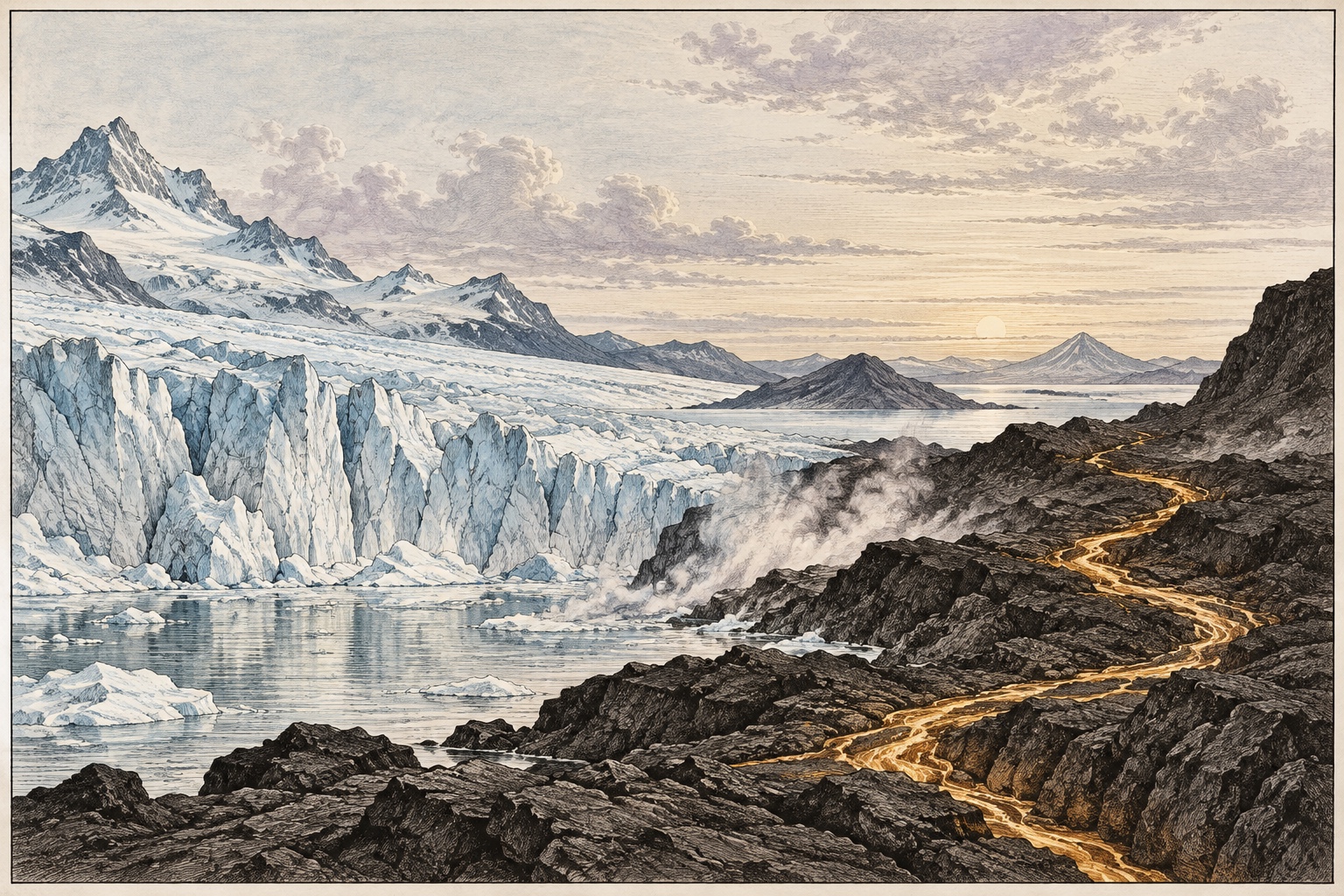
My homeland of Iceland is built on a paradox: magma boiling beneath glaciers. The ice (Structure) does not extinguish the fire; it pressurises it. The fire (Flow) does not melt the ice instantly; it shapes it. Polarity is not a compromise where two forces meet in the middle; it is a geological event where two extremes coexist to create new land.
When Pressure Rises
Beneath a glacier, molten rock meets a weight it cannot ignore. Ice melts at the seam, and the water runs along the cooling rock. What hardens there changes the course of the next flow.
A body moving alone can follow an inward image. In encounter, another body changes the space in which that image can take form. A turn meets a different pace. An offered hand arrives at a different height. The movement imagined a moment ago has to meet the person who is actually here.
Structure gives an action enough direction and continuity to be met. Flow lets it change through the meeting. Both belong within each participant: the person initiating a movement also receives its answer, while the person responding gives the encounter a new direction.
These are capacities, not genders. Their correspondence with yang and yin is partial: those symbols carry traditional masculine and feminine associations, but neither capacity belongs to a sex or gender.
A Life Between Opposites
One foot takes the weight and stays. The ribs keep filling, and the stance holds over the open floor. The other person has not yet answered. When their step changes the distance, the standing knee eases, and the weight remains.
The Pillar is the form a person can sustain long enough for another to meet it. The Wave is the movement that travels through and changes that form. In a shared dance, the turn must have enough shape to be followed, yet remain open to the path the other body takes. Too little continuity leaves the partner chasing a movement that keeps withdrawing. Too much insistence makes their response irrelevant.
Leading and following each require both capacities. A person who follows contributes timing, distance, and the particular way their body moves. The reply enters the next movement before either person has finished what they began.
Polarity in Relationships: Attraction and Intimacy
Attraction sometimes becomes palpable in the interval between a movement offered and a movement returned. Attention gathers around the space between bodies: an approach slows, a hand lingers, a turn leaves an opening. Anticipation gives the smallest movement weight. Both people may be active in that interval even when only one is visibly moving. In conversation, one person pauses mid-story, and the other’s laugh changes the next sentence.
Pleasure can arise from being met precisely enough to risk surprise. A familiar touch changes in pressure; the person receiving it moves towards a different point of contact, and the first hand follows. Neither person could produce that exact encounter alone.
Touch requires willing participation, and bodily response never substitutes for consent. Attraction also has its own contingencies; no arrangement of poles guarantees it. The same capacities can support friendship, shared work, or quiet companionship. Their value lies in the contact they make possible, whether or not it becomes erotic.
Recovering Range
A step or held pause meets the other person’s response across a changing distance. Attention can follow the other so completely that one’s own direction fades. It can also narrow around a rehearsed path until the other barely enters awareness. Range includes feeling one’s own action while remaining available to what happens between bodies.
Two people can copy each other’s gestures accurately while neither changes the other’s course. Here, a pause or change of angle matters through what it makes possible for the other body. The movements may differ in both shape and timing.
Difference also has texture: reach, pace, mobility, fatigue, and familiarity with the movement all matter. A gesture that is effortless for one person may take the other’s full attention. The shared form grows from the bodies present, including their limits; an ideal performance imposed on them can obscure the very encounter it was meant to enable.
4–4–6 Breath
For an optional rhythm, sit or recline comfortably. Breathe in for a count of four, pause softly for up to four, and breathe out for six; repeat for a few comfortable cycles. Shorten or skip the hold if it adds strain, and let the counts shorten too if needed. Stop if discomfort appears. Return to ordinary breathing and notice the response.
Relational Range
Consider two people dancing with space between them. One begins a broad turn, expecting the other to remain opposite. Instead, the other steps into the space the turn is about to sweep. Continuing unchanged would close the passage between them. The turning dancer shortens the next step and turns the shoulders through a smaller arc; the crossing dancer now has room to pass without touching. As they come alongside, the first pauses, and the second curves back into the newly opened space. What began as facing each other has become a figure that briefly carries them side by side.
A missed turn may end in laughter or simply break the phrase. Repeating the intended figure more forcefully will not recover the meeting that was missed. The next beginning has to use where the bodies have actually arrived. Sometimes the interruption becomes the most interesting part; sometimes the dance is finished.
Inner Union: The Alchemy of Polarity
Another person’s timing can draw out an ease, boldness, or playfulness that had no occasion to appear alone. A remembered movement remains an option to explore: the curve that felt strange, the pause that gave it room, the unexpected pleasure of arriving alongside. Making it available without that first partner takes practice, and it will change again in another meeting. Inner union grows through these additions to what the body can inhabit, as well as through inward work.
In Dorn’s alchemical marriage, as Jung reads it, soul and spirit have found each other, but their union still has to return to flesh. Dorn’s further horizon is the unus mundus: a potential “one world” beneath the multiplicity of things, a wholeness extending beyond the private psyche (Mysterium Coniunctionis, §§664, 760).
In the image of the mythic lovers, union brings forth a form neither contained in advance. The dancers remain distinct, yet the figure has a life between them: each carries it, neither can perform it alone. Sacred marriage opens a wider possibility—that this finite act participates in a generative depth neither person owns or exhausts.
What the Body Carries
The turn, the pause, and the next attempt are carried by bodies that tire, remember, and learn. What becomes possible between them still has to take root in flesh.
From Practice to Physiology
Repetition changes us.
Every breath practice, every pause, every turn offered, every answer that changes how you move— it all lands somewhere specific: in tissue, in chemistry, in sleep, in stress, in the body’s learned sense of safety and threat.
Practice is not separate from biology. With repetition, recovery, and conditions the body can bear, practice can alter what becomes easier to do.
So before we move further, we go lower.
Beneath insight. Beneath story. Beneath even the beauty of discipline.
We enter the crucible where the path must answer to flesh.
Here the body does not decorate the teaching. It tests its cost, capacity, and degree of integration.