Part V
Chapter 28: The Soul’s Armor
Estimated reading time: 12 min
“The walls we build around us to keep sadness out also keep out the joy.”
— Jim Rohn
In nature, scales protect vulnerable tissue—the underbelly, the eyes, the tender seam at the throat. This is natural. This is survival.
Use this map for self-location and boundaries, not as a diagnosis of yourself or anyone else. If you are in immediate crisis, bring in experienced, grounded support; do not ask this map to carry a crisis.
But protection can overlearn.
When vigilance spreads into every channel, it cannot tell when the threat has passed.
When defence covers perception, contact, and feeling alike, the same strategy that once preserved life begins to distort it.
The armor that saved you can become the cage that keeps you living inside yesterday’s war.
Here, Energetic Armor names protection built under unbearable strain that has become difficult to put down.
When safety inside the Foundational Relational Matrix breaks early in life—when a caregiver is a source of terror, or the child’s being is unseen—the psyche may build protection rather than simply break.
It hardens. It twists. It builds a fortress.
Two commitments keep this map ethical:
- Compassion: To remember the vulnerable life inside the suit of iron.
- Protection: To recognize that iron cuts. Protection can injure the people it once meant to keep close.
Before interpreting a defence, hold the distinction between wiring and wounding. Neurodivergent difference must not be mistaken for trauma-shaped protection.
The Difference Between Wiring and Wounding
Neurodivergence, including autism and ADHD, is a difference in wiring—a variation in the living architecture of the Form Body.
The Soul’s Armor, in this map, names wounding: rigid protection shaped by trauma.
Autistic shutdown, sensory overwhelm, blunt speech, or slower processing can be misread as manipulation, coldness, or lack of empathy. That misread is itself a harm.
- Neurodivergence: Wiring changes how sensory and social input is received, processed, and expressed.
- Armor: Wounding can narrow response around protection, repeating old survival rules after conditions change.
The same person can be both neurodivergent and trauma-armored; one does not cancel or explain away the other.
Curiosity begins with the person and the situation: what support is missing, what has happened, and what do they say they need? Fatigue, sensory strain, an unfamiliar room, or a real threat can change how someone responds. Their account may correct the first impression.
Neurodivergence often calls for accommodation and support. Armor calls for deliberate integration practice—and, at times, firm boundaries.
Armor is a survival model that learned one world too narrowly, rather than a fixed essence.
The Overfitted Nervous System
Borrowing a technical metaphor, a model “overfits” when it learns one environment so narrowly that it mistakes local conditions for the laws of reality.
Trauma adaptations can do something similar. Your nervous system learned what got you punished, what got you praised, and what kept you safe. Armor is often the strategy that fit that world.
The strategy becomes a problem when the model stops updating: it keeps predicting threat when conditions have changed and carries yesterday’s survival rules into today’s relationships.
Shadow work slowly and safely widens the range of experience so the system can learn again. That means new experiences of consent, boundaries, repair, and co-regulation, repeated with awareness and discernment until the body has enough evidence to update.
Before going further, locate one live edge in yourself: where does rigidity replace softness, defence replace openness, or numbness replace feeling?
Start there. That is where the armor lives.
This pause keeps the map honest. Without it, armor language becomes a weapon; with it, the map stays a mirror and a boundary tool.
The Mirror Rule: Use this map for self-location first.
Begin with a response you recognize in yourself and the situation that brings it out.
With another person, name what happened and leave room for their account. A boundary can stand without a theory of their inner life.
How Protection Narrows Choice
A response that begins under threat can become a habit. Seeking admiration, reaching urgently for contact, trying to control uncertainty, and withdrawing from others are four ways protection can narrow choice. One person can move through several of them as circumstances change.
A hurried reply, a planned routine, or a quiet evening needs no theory of armor. The concern is a response that keeps overriding present conditions and making contact or choice harder.
Similar behaviours can have different histories. Where clinical questions arise, assessment considers symptoms, history, functioning, and other explanations.1 A metaphor cannot do that work.
Armor can also harden into narrated identity. When bodily terror outruns tolerable feeling, the mind’s story-making layer rushes in to make the danger coherent. The story tells you who you must be, what others are, and what will keep you safe.
Sensation and narrative then reinforce one another until the protection feels fused to the self. In graph language, an old survival circuit can remain strongly connected within itself while receiving little present-time evidence of safety. Change begins when new experience can reach it. A different response from a trusted person, a respected no, or a correction received without punishment can make room for a slow molt.
1. Seeking Worth Through Admiration
For someone whose worth was recognized mainly through performance, being impressive can feel safer than being seen. Praise briefly steadies the self; ordinary disappointment, rejection, grief, or correction can feel like threats to existence.
Neurodivergent masking is different. A polished or carefully managed presentation may be a translation strategy for surviving environments hostile to a person’s wiring. Appearance alone does not reveal whether someone is seeking admiration, managing sensory strain, or trying to be understood.
The Fundamental Attribution Error lies in explaining behaviour through character while overlooking conditions. Admiration-seeking may protect a shame wound; that possibility is a reason for curiosity, not an account to impose on someone.
When keeping the image intact takes priority, a person may deny what happened or reverse the account. Others are pressed to praise, reassure, or withdraw a correction. The cost lies in those acts and in what becomes impossible to say.
The loosening begins with contact that survives being ordinary: admitting a mistake, receiving a correction, or spending time together without having to impress. Grounding returns the person to the humble reality of being human: imperfect and mortal, therefore equal.
2. Reaching for Contact Under Fear
Early attachment that swings from terrifying closeness to sudden abandonment can be one route into urgent pursuit of contact. A person may track every change in tone because noticing small shifts once helped preserve connection and safety.
Under fear, a pause can feel like rejection. Someone presses for an immediate answer, accuses before asking, or retracts a boundary to keep the other person close. Faces tighten, voices quicken, and the room starts managing the surge.
Flooding carries information, but it does not get to decide truth, action, or another person’s boundary. Flooding alone says nothing about manipulation. Coercive conduct is judged separately, through observable behaviour and its effects.
Another response is over-repairing: rushing to explain, confess, soothe, or make oneself smaller before locating the truth of what happened. A person apologizes for having a limit, retracts a clear boundary because someone disliked it, or promises more access than they can sustain.
This can look mature because it borrows the language of accountability. But the engine may be abandonment panic: Please do not leave. I will carry the whole rupture if that keeps the bond alive. Grounded repair leaves room to name impact without abandoning oneself.
The missing capacity is often healthy aggression: the outward protective force that lets the body hold a limit. When that force feels dangerous or unavailable, the self gets bargained away to preserve contact.
Accusation and appeasement can serve the same urgent aim: keeping the bond from breaking. The work includes tolerating pauses and disappointment while learning that contact can survive truth. Accountability still matters; it need not take the form of immediate reunion.
Integration practice includes steadier bodily support and learning to tolerate the sensation of aloneness without collapsing into abandonment.
3. Trying to Control Uncertainty
When unpredictability has meant danger, safety can seem to depend on scripting every variable. The response shows itself in clenching, checking, rehearsing, and correcting.
Structure supports a life; rigidity requires life to obey the plan. A changed arrangement feels intolerable. Another person’s way of doing something becomes a mistake to correct. Partners may feel constantly assessed rather than met.
Here Flow has little room. The prison is built from familiar materials: useful routines, careful plans, the wish to get things right. What narrows choice is the insistence that no other way can be allowed.
Integration practice lets Flow move inside stable Structure: one small mess, one unscripted breath, one tolerable uncertainty at a time. The practical question is whether a change can be negotiated without one person having to govern the other.
4. Withdrawing from Contact
Under overwhelming strain, a person may retreat from conversation and shared feeling. They answer only practical questions, stop expressing needs, or find it hard to take in what another person is saying.
Distance can also be a needed boundary. Someone taking space after conflict is different from someone repeatedly refusing to acknowledge harm or treating others only as useful. The difference becomes clearer through what happened, what was communicated, and whether each person’s limits are respected.
When withdrawal hardens, appeals to shared feeling may not change the conduct. Repeatedly ignoring a no, using another person for what they provide, or refusing to answer for harm calls for protection. A partner or friend cannot carry the work alone.
Change remains possible, sometimes with experienced, long-term support. Compassion here takes the form of a firm boundary. When conduct repeatedly reduces people to objects or tools, safety comes first. Do not try to manage the pattern alone.
The Ethics of Armor: Compassion Without Collapse
Compassion leaves room for a history we may not know. Protection answers what is happening now.
However, compassion is not permission.
You cannot do someone else’s healing for them. Taking that work on as your responsibility can put you at serious risk of harm. Understanding someone’s history is not permission to tolerate abuse.
A drowning person may climb on top of you to breathe.
You can have compassion for their panic, but you must not let them drown you.
When Armor Hurts Others
When these responses appear in life (or in the mirror), the Sage’s Compass guides the response: consider the context, judge the action, and choose the next clean boundary.
Make room for history; judge the action. Compassion can ask, “What happened for you?” Boundary can answer, “I want to understand. I will not stay in a conversation where I am being threatened.” Listening does not require surrendering what happened, and the explanation can change without dissolving the boundary.
Refuse the assigned role. If you notice yourself being pulled into the role of audience member, rescuer, subordinate, or the one expected to manage the fallout, pause before you perform. Track the role being demanded of you rather than explaining the other person, and decide what boundary preserves your reality.
Rebuild safety where safety is possible. Attack usually hardens armor. When consent, accountability, and steady contact are present, the system has room to soften; where those conditions are absent, distance protects what matters. A boundary might sound like: “I can see you are in pain. I am not going to fight you. I am also not going to comply with this demand. I will step away until we can speak without pressure, punishment, or reality distortion.”
Melting the Metal
If you recognize this armor in yourself, know this: You forged it to survive.
It served its purpose. It kept the softest part of you alive through the winter.
The winter may not vanish, but even one pocket of safety can reveal where the protection that once saved you has begun to close around you.
The work is not to rip the armor off. That would flood the system and prove the armor right.
The work is to restore range.
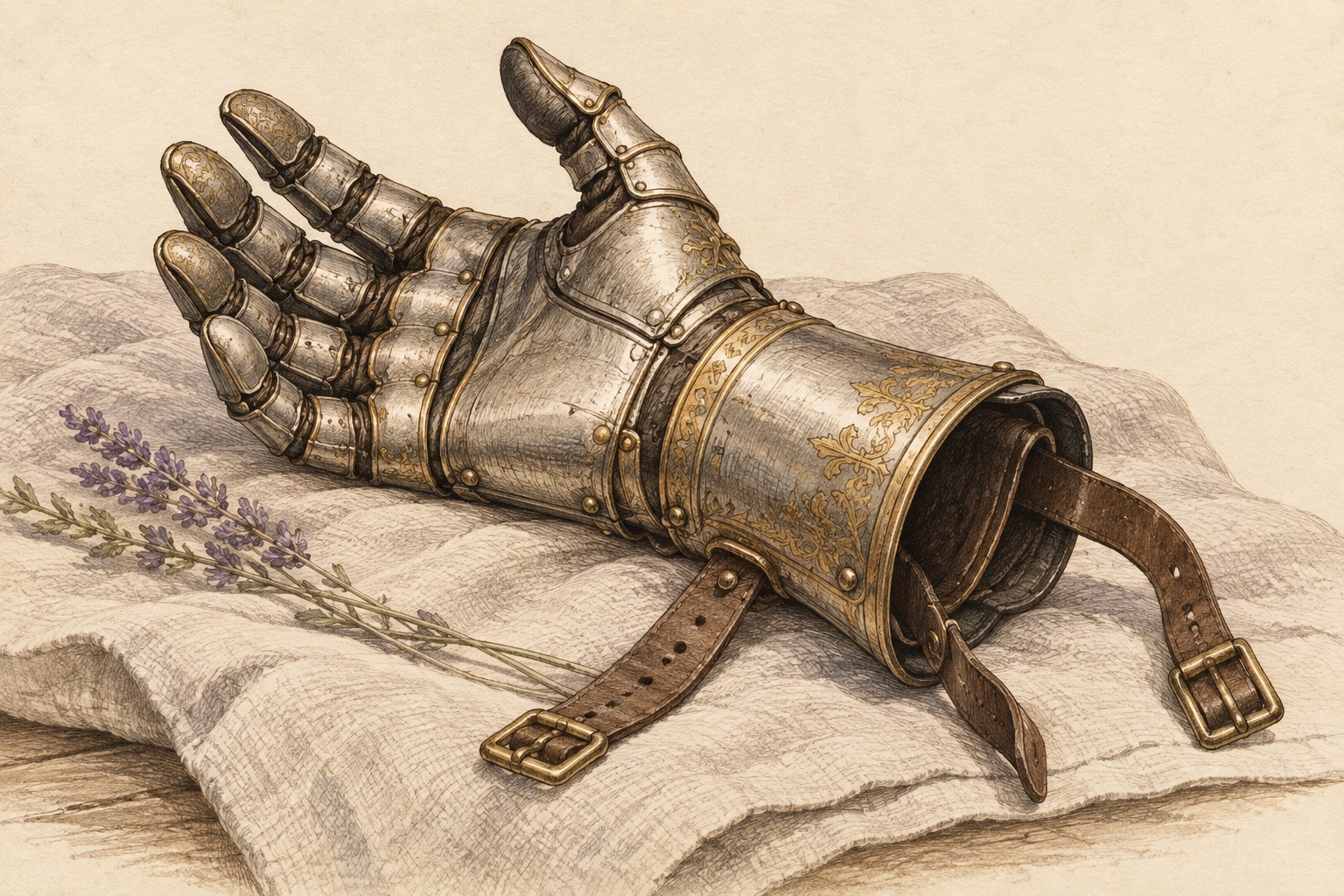
The Dragon contains its defences; the cage forms when a defence contains the Dragon.
Its fist closes around what it most longs to keep; when the grip releases, what it loves lies crushed in its palm. Armor draws tight around its ribs, closing the heart against injury—and against the love it still yearns to receive.
Restored range gives choice back to the living system. Armor softens when safety is present and holds firm when danger is real. The system can register safety without surrendering the power to defend what matters or collapsing back into yesterday’s war.
Restore warmth to the body from the inside. Use somatic awareness, Inner Child work, and breath to generate internal warmth rather than waiting for the outside world to feel safe first. Notice where you are holding, soften on the exhale, and offer the younger part still bracing one concrete provision: water, rest, reassurance, or a boundary.
Next, restore movement. Let Trickster humor loosen rigidity, and let Lover softness restore contact. Find one place you can loosen the grip today. Pair a small laugh, a playful reframe, or a less-than-perfect attempt with one act of gentleness toward yourself.
Finally, test permeability only in safe conditions. For mild armor, choose a therapist or a small, steady circle that has already proven it can respect a no, pacing, confidentiality, and repair. If the armor is severe, fused, or high-risk, this belongs with experienced, long-term support; do not hand it to a partner or peer group.
Let the experiment stay small. Lower the guard for ten seconds, then twenty. “I’m going to say the true thing for ten seconds. Then I can come back to my armor if I need to.” Track what happens in your body: did you survive being seen, and what strengthened—capacity, honesty, or choice?
That is how armor integrates: not by being shamed, ripped away, or managed from above, but by receiving repeated evidence that protection can stay available while contact, choice, and truth return.
You are not the armor.
You are the living system beneath it.
With enough safety, repetition, and honest support, protection can become range again—metal remembering it was never meant to be the whole skin.
NICE Quality Standard QS88 calls for structured clinical assessment when diagnosing borderline or antisocial personality disorder. NIMH’s overview of borderline personality disorder describes varied risk factors, overlapping conditions, and assessment by a licensed mental health professional. These sources support the assessment boundary.↩︎