Part VI
Chapter 34: Tools for the Path
Estimated reading time: 16 min
In the territory of intimacy and power, accountability is the bridge from impact to clarity and from unintended harm to repair when repair is possible.
It is also the bridge from confusion to the boundary that tells the truth when repair is not.
Let Living-Consent be more than a phrase; let it be a living sense in the body—an honest “yes,” a firm “no,” a sacred “not yet,” and the dignity of changing your mind.
A bodily yes is important information. It is not the only information.
These tools fail when they stay in the head. Communication is a little like releasing an arrow: the body is the bow, the words are the shaft, and tension, release, and intention shape the shot. How it lands still depends on conditions and the nervous system it meets.
A tool is a vessel for current, not a substitute for presence.
Choose a tool when there is something it helps clarify: an uncertain agreement, a breach of trust, a conversation that keeps going wrong. Ordinary contact needs no preliminary audit. Under pressure, the Serene Center offers enough ground to choose; neither speech nor an exit has to wait for perfect composure.
1. The Wheel of Consent
Honouring the work of Betty Martin.
The Wheel of Consent distinguishes Serving, Taking, Accepting, and Allowing through touch, attention, conversation, and facilitation. It makes the agreement clearer while each person remains free to guide, pause, or stop contact.
It asks two fundamental questions: Who is doing? and Who is it for?
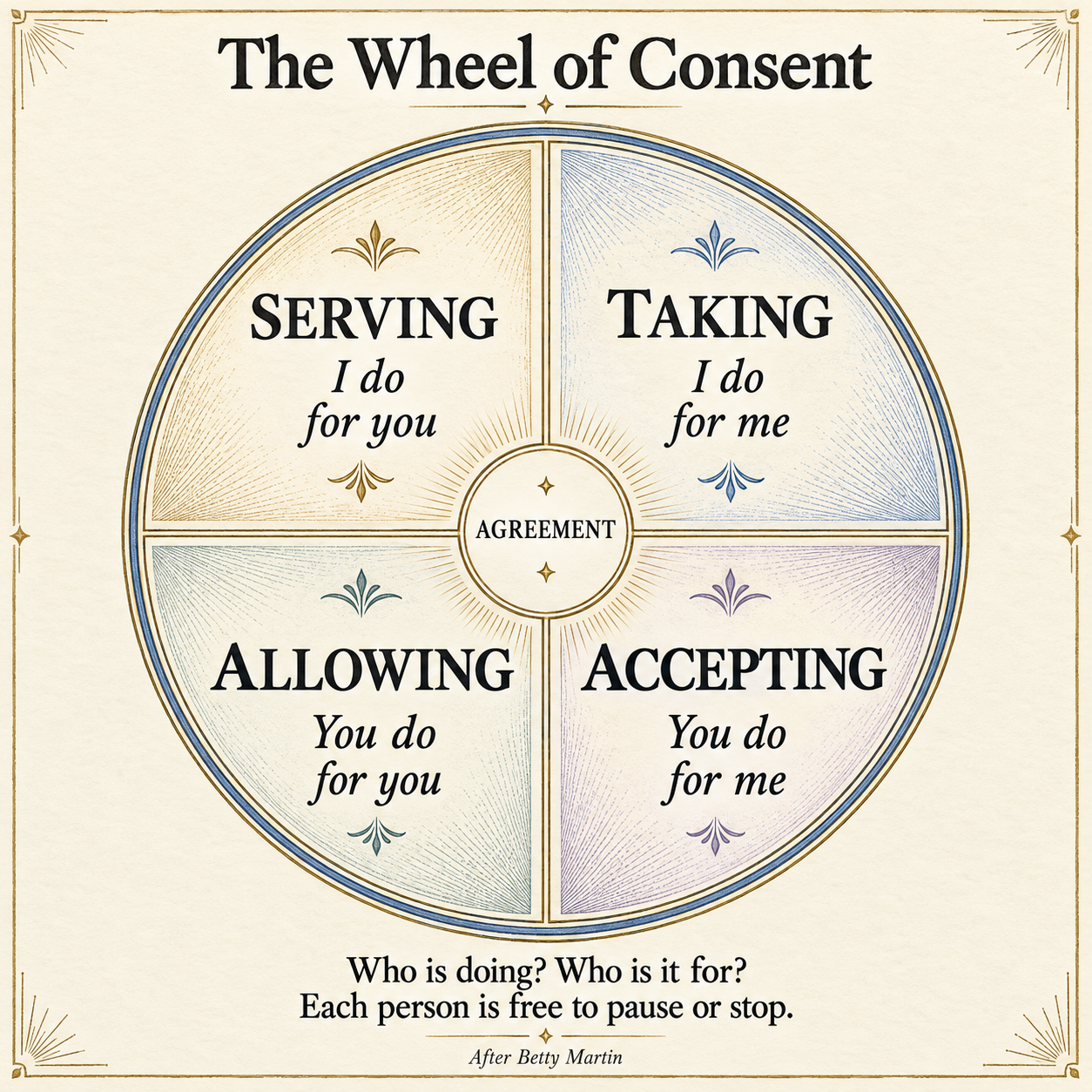
The Four Quadrants of Connection
1. Serving (I do, for You)
- Offer your energy to support another.
- Watch for martyrdom when you’re depleted—giving to be liked rather than to serve.
- Check: “Do I have enough capacity and surplus to give without resentment?”
2. Taking (I do, for Me)
- Reach out and claim what you desire, with explicit permission.
- Be wary of theft or entitlement when fear, shame, or scarcity is driving.
- Check: “Am I willing to hear ‘No’ without collapsing?”
3. Accepting (You do, for Me)
- Receive what has been explicitly agreed, staying present enough to pause, guide, or stop.
- Watch for signs of dissociation or fawning if your body feels unsafe.
- Check: “Can I stay present in my skin while I receive?”
4. Allowing (You do, for You)
- Stay present while another takes what they want, within your explicit consent and boundaries.
- Watch for resentment when you didn’t set a limit.
- You are the mountain only if your boundary is real.
- Check: “Is my boundary clear enough to hold their fire?”
When an agreement feels muddled, identify who is doing and who it is for. Help offered in exchange for unspoken approval leaves a bargain hidden. Naming that wish makes an honest answer possible. Bodily bracing alone does not establish a mismatch; the person’s account and freedom to choose matter.
2. Embodied Nonviolent Communication
Honouring the work of Marshall Rosenberg.
Under pressure, divided self-states can pull speech in different directions: emotions say one thing while words say another.
When a trauma-bound part is driving the exchange, the tool is not there to silence it. The tool gives the adult system enough structure to stay present, so the younger or defended part can be heard without taking over the whole contact.
Nonviolent Communication is a protocol for coherence rather than a performance of niceness.
The four steps separate what happened from what it stirred and what is being asked:
Observation: What actually happened? Strip away the story. What can another person observe?
Clean sentence: “I walked in and you did not look up.”
Feeling: What sensation is present? Where is the charge?
Clean sentence: “I feel a constriction in my chest. I feel lonely.”
Need: What need is present, and what deeper value does it point to?
Clean sentence: “I have a longing for connection and acknowledgment.”
Request: Make one concrete request the other person can freely accept, refuse, or renegotiate.
Clean sentence: “Would you be willing to pause for two minutes and sit with me?”
The Dragon’s Distinction: NVC can be used as a script to steer others into compliance. The Dragon uses it to reveal the self.
An honest request leaves room for an answer the speaker did not want.
A Different Answer
Standard NVC can sound robotic. Embodied NVC keeps the person inside the form.
Changing the form to protect the core is a more mature authenticity: the same center finding a clearer way to speak.
This is one reason tools matter. Under pressure, the oldest defence often speaks first. A deliberate sentence shape, a consent script, or even a consciously chosen role can function as scaffold rather than mask. It does not hide the self; it helps a truer signal come through before defence starts steering the contact.
A partner habitually interrupts you. Standard NVC might sound like this: “When you interrupt, I feel annoyed because I need respect. Please let me finish.” The sentence is valid, though it can sound crisp and clinical. The embodied pivot starts earlier: feet on the floor, jaw unclenched, a spike of heat in the throat, and the deeper value remembered beneath it. I value my voice. I am not a child being silenced. Then the speech changes: “My throat is tightening. I want to stay connected, but I’m fighting to speak. Can you let me finish?”
3. The Trust Inventory
Trust is built and tested through repeated moments of consent, honesty, and repair. In the language of the Entangled Firmament, it is the tensile strength of the threads connecting you to another.
When trust feels shaky, do not ask, “Do I trust them?” That is too vague.
Ask: “Which thread is fraying?”
The Four Threads of Trust:
- Sincerity: Do they mean what they say? Are their values visible?
- Reliability: Do they do what they say? Can I predict their actions?
- Competence: Do they have the capacity to do what they promised?
- Care: Do they hold my best interests alongside their own?
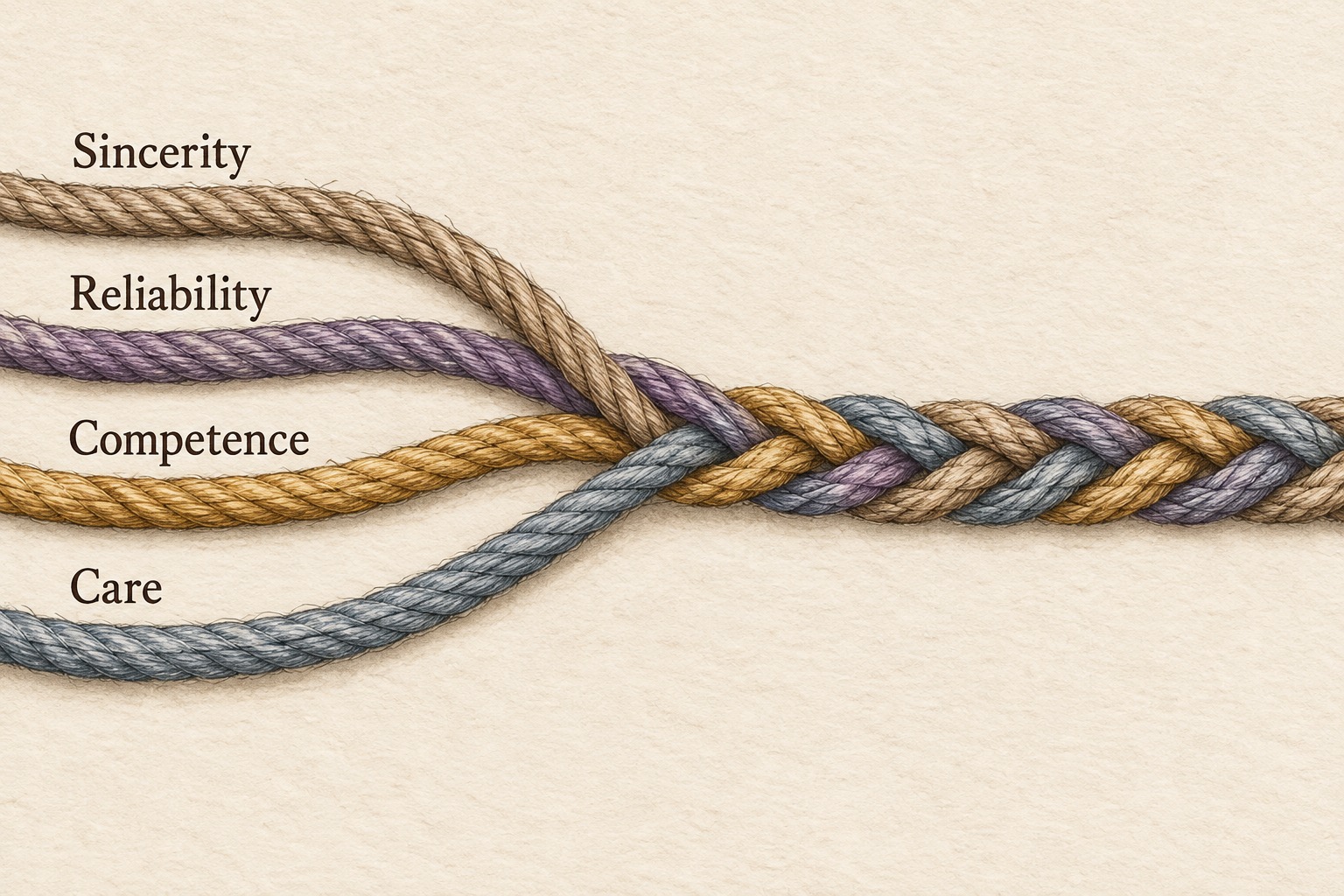
Start with the thread: If you feel unsafe, identify the specific thread.
“I trust your Care (you love me), but I do not trust your Reliability (you are always late).”
Naming the specific thread moves you out of judgement and into discernment about what can actually be repaired.
A schedule problem can be addressed. A verdict on the person cannot repair trust.
When trust work touches old trauma, the task is not to drag every hidden part into the conversation. Resource first when the exchange can wait. Stay with what happened, what needs to change, and each person’s dignity.
Changed conduct gives trust something to grow on. An apology for lateness gains weight when the person starts arriving when agreed.
4. Tools for Different Minds
Every nervous system meets reality and relationship in its own way. The tools must bend to the person, not the person to the tools.
Consent stays legible and dignity intact when the tool fits the nervous system it serves. Alexithymia and processing delay shape how a person tracks contact; they are not bad faith or failed communication. They change how consent needs to be checked.
For alexithymia, when identifying emotions is difficult:
- Skip the “Feeling” step of NVC if it causes freeze.
- Use sensation instead. “My stomach is tight” is a valid body-based statement when emotion-labelling freezes.
- Use capacity/energy instead. “My capacity is low right now” is a valid boundary.
For processing delays:
- A person may need time to know their answer. While the answer is pending, the interaction pauses.
- “Let me think about it” is a valid response.
- Step away: Pause the interaction. Check the body. Return when an answer is available.
5. Checking Your Blast Radius
Interconnection carries consequence as well as comfort. Your inner state does not stay inside you—it travels through tone, timing, and behaviour. When the Serpent is activated, the same voltage that could protect can also scorch.
Before consequential action, especially when activated, use the Blast Radius Check:
- Magnitude: What is the magnitude of this action? (Is it a whisper or a scream?)
- Blast Zone: Who is in range of the ripple? (Children, students, people under your authority, partners?)
- Containment: Is my containment strong enough for this voltage?
If your influence is high and your capacity to choose is low, the next action carries extra risk. Stop. Ground, or let another person take the lead until choice returns.
This dignifies restraint. Sometimes holding back is the most loving protection you can offer the web.
6. The Generous Interpretation
NVC and boundaries are powerful, but they can become weapons if wielded by a suspicious heart. Before you confront, run a Generous Interpretation.
When you feel slighted, the threat system may draft a story of malice: “They did this to disrespect me.”
Ask your Sage for three plausible readings that do not presume malice:
- “They are overwhelmed and forgot.”
- “They are carrying pressure I do not know about.”
- “They are using a different map for this situation.”
Acknowledging that these stories are possible is enough; belief is unnecessary. This lets the Eros Body soften from defence into curiosity.
Generosity is not self-erasure. Repeated evidence, unsafe conditions, or a clear boundary violation end the exercise. Reality comes first.
Then speak or set the boundary from that clearer place. If the pattern persists, act accordingly—but do not let your first draft be war.
7. The Reality Tether
When someone’s narrative about you departs severely from your experience of what happened, this tool keeps you anchored to observable facts without surrendering them just to keep the peace.
Picture the moment after a hard exchange when the room has split into two incompatible stories. Your pulse rises. Part of you wants to explain every motive; another part wants to collapse and agree just to end it. The Reality Tether asks for something simpler.
Start with what is observable. Acknowledge their experience without swallowing it. State what you actually did. Name the gap. Set the boundary. Then offer only what is truly possible: a pause, a consequence, a repair, a third party, or an end to the exchange. The point is not to win the story. It is to keep reality from tearing in half inside you.
A truthful boundary does not require a final verdict on another person’s motives. Ask what you observed, what you inferred, and what would change your reading. Then take the proportionate action the evidence can carry. Leaving the explanation open does not require leaving the door open.
Those who hold structural power should not use this tool to clear themselves. They should step back from judging their own case, seek the strongest scrutiny beyond their direct influence, and remain answerable for impact, consequence, and any repair that is actually theirs. Where no independent route exists, that limit must remain visible.
Example:
- Them: “You attacked me!”
- You: “I hear that it felt like an attack. I wasn’t trying to hurt you. I need a pause; then I’m willing to look at what happened.”
Even a request for space has a tone, timing, and impact. If both people choose to return to the conversation, review the words, tone, timing, and impact. They can also seek a third person’s help, with that person’s role and ties made clear.
8. The Repair Protocol
Accountability requires capacity. When shame floods the system, protection can take over: denial, blame, counterattack, or a collapse that leaves the harmed person managing your shame instead of their own pain.
Self-compassion makes remorse more bearable, so a person can stay present to impact and face what must change. It does not excuse the harm or make the harmed person responsible for restoring that capacity.
Repair is no licence for avoidable harm. Some consequences outlast apology; forgiveness, reconciliation, and restored access remain separate choices.
When impact lands and truthful contact remains possible, the Repair Protocol moves through six steps:
- Pause and acknowledge: “I hear I’ve impacted you. I want to understand.”
- Listen: Hear their full experience without defending.
- Reflect: “What I’m hearing is…” Confirm that you got it.
- Own and apologize: Name specifically what you did (the Beam you sent), own the impact, and offer a plain apology for the harm caused.
- Ask: “What would repair look like for you?”
- Follow through or renegotiate: Do what you agreed, or clearly name what you can and can’t do.
When Repair Isn’t Possible:
Repair is one honourable response to rupture, not the only mature one. Sometimes the truthful move is a boundary, Clean Severance, or the refusal to keep negotiating with coercion.
An unsafe encounter can be left immediately. Clean Severance does not require finishing an accountability process before departure. Responsibility for one’s own conduct remains: harm can be acknowledged and amends arranged afterward through safer means, without renewed direct contact.
Sometimes the ask is for you to:
- Confess to intent you didn’t have
- Erase your own reality
- Accept infinite penance
- Become responsible for their healing
Sometimes the pattern is the problem more than the ask. If every explanation becomes leverage and “communication” is being used to extract compliance, stop explaining. Leave the exchange. A boundary can be stated when doing so is safe.
There comes a point where explaining yourself stops being communication and becomes self-erasure.
Bodily settling after an ending is not an ethical verdict. Sleep and appetite can return after either a necessary boundary or an avoidant escape. What follows matters: honest conduct, accountability for harm, and distance held without coercion or retaliation. Ending contact neither erases responsibility nor obliges the harmed person to receive an apology or return.
9. Common Ethical Dilemmas
A few hard moments, and a clearer response to each:
Dilemma 1: “They’re Crying So I Must Be Wrong” You set a boundary. They cry or collapse, and you feel like a monster. The pitfall is rescinding the boundary to stop their pain. Their pain matters; it does not automatically make the boundary wrong. The grounded response is: “I see you’re hurting. My boundary stands. What support do you need from yourself or others right now?”
Dilemma 2: “The Whole Community Believes Them” A harm report spreads through a community, and you are named as the one who caused it. The danger is frantic defence or collapse into shame. Community pressure is not proof, and reports that arose separately are not noise. Take the report seriously. Where you hold authority implicated in it, step back from that role. The reporter’s access to review remains theirs; the authority-holder neither obstructs nor mediates it. If only internal review exists, let that limit remain visible.
Silence, spin, and self-investigation cannot answer structural power. When an appropriate process asks for your account, give it plainly: what you know, what you do not, and what you are willing to repair. Then stop trying to manage perception. Let your conduct over time speak.
Dilemma 3: “I Reported a Breach. They Called It My Pattern.”
The retreat’s opening agreement is plain: private conversations stay private. On the second morning, the facilitator repeats a participant’s private account in the circle. He leaves out her name, but the details identify her. Two people turn towards her. She had given no permission to share it.
After the session, she says, “I told you that in confidence. You used it in front of everyone.” Her voice shakes.
“I hear how exposed you feel. Could this be old shame about being seen?”
She repeats the limit: “I didn’t agree to share it. I want you to stop using it in your teaching.”
He offers a conversation with the retreat’s elder, describing it as independent review. She asks who the elder is.
They trained him, teach alongside him, and help choose who returns to assist. When she asks the organizer for the breach to be acknowledged and the unused part of her fee returned, the offer is a meeting with the facilitator and this same elder. No hearing outside that circle is offered.
She declines the meeting; she does not want another room in which they interpret her while deciding what happened. She leaves a short written account of the agreement, what was said, and who was present, and keeps a copy.
A friend outside the community helps her arrange a ride and somewhere to stay. She can decide later whether to pursue the complaint.
No apology comes before she leaves. The money remains unresolved. In the car, she is still angry and misses the people she had hoped to know.
At her friend’s kitchen table, she puts the written account away for the night. There is food, a spare bed, and no further circle to face.
The broken agreement remains the fact to answer. Leaving has not made the breach her fault; the retreat still owes her an answer.
Dilemma 4: “I Did Cause Harm” You realize your behaviour had jagged edges, or multiple people reflect a similar impact. Someone named harm, and you feel defensive or ashamed. The trap is explaining intent to avoid impact—or collapsing into self-erasure instead of repair. The grounded response is to own the behaviour plainly, ask what landed, and offer a specific repair and a change in conduct. In roles with structural power, step back from the role while changed conduct is tested over time.
The Tool Is Not the Work
The tool serves contact; contact is the work. These practices matter only when they strengthen the relational vessel: keeping consent and exits clear, reducing preventable harm, and answering impact when it occurs.
Use them before charge becomes action, or when the room is already reacting. Your state enters the room before your script does. Grounded presence serves contact better than a perfect script.
Bearings Under Heat
Under pressure, the wish to be understood can crowd out the willingness to understand. You explain your intention again. The other person is still speaking about what happened.
An agreement may need clarifying. A promise may need keeping. Harm may call for repair, or a boundary may end the conversation without resolving the disagreement. Discernment includes recognizing which of these is actually before you.
Where you hold authority, your account carries additional weight. If the report concerns your conduct, step back from deciding its merits and seek the strongest scrutiny beyond your influence, with its limits named. Another person’s access to support must not depend on persuading you.
From Ethical Fire to Sacred Silence
Before entering deeper stillness,
remember what has already been asked of you:
not transcendence,
but dignity.
not specialness,
but responsibility.
not intensity,
but integrity under charge.
This matters because any contact with the infinite
that loosens your bond with consent, repair, or boundary
is not depth.
It is drift.
The Void is not proof of depth.
It is not rank.
It is not escape.
It is simply another chamber of encounter—
one that asks for grounded presence,
humility,
and the ability to return.
If you enter,
enter lightly.
If you do not,
the path remains whole.
Silence does not make you truer.
It reveals what you bring into it.