Part VIII
Chapter 44: The Resonant Dragon
Estimated reading time: 17 min
There is a grammar beneath the song, holding its shape at every scale.
By now, the path has circled one pattern from many angles: the same tangles returning in new faces, the same wound learning a different song, the same old charge meeting a deeper center.
It is more than repetition. Coherence enters one local act, corresponds across levels, and echoes as change across scales until body, bond, story, and field begin to answer one another.
Call it Fractal Resonance.
The Dragon is an archetypal pattern lived in flesh: what a system looks like when it remembers it is both whole and part.
Here Fractal Resonance names a contemplative model for a self-similar, participatory field: from cell to psyche, from intimacy to cosmos, patterns rhyme across scales without collapsing into sameness.
The path is not from separation to unity, but through both toward coherence. The sense of absolute separation is one of the nervous system’s survival stories: local, useful, and partial. Unity is the felt relatedness glimpsed when that story loosens. Coherence is what remains when both are tested in the body, in relationship, and across scales.
The law beneath this is simple:
Form is stabilized flow.
Flow is form becoming again.
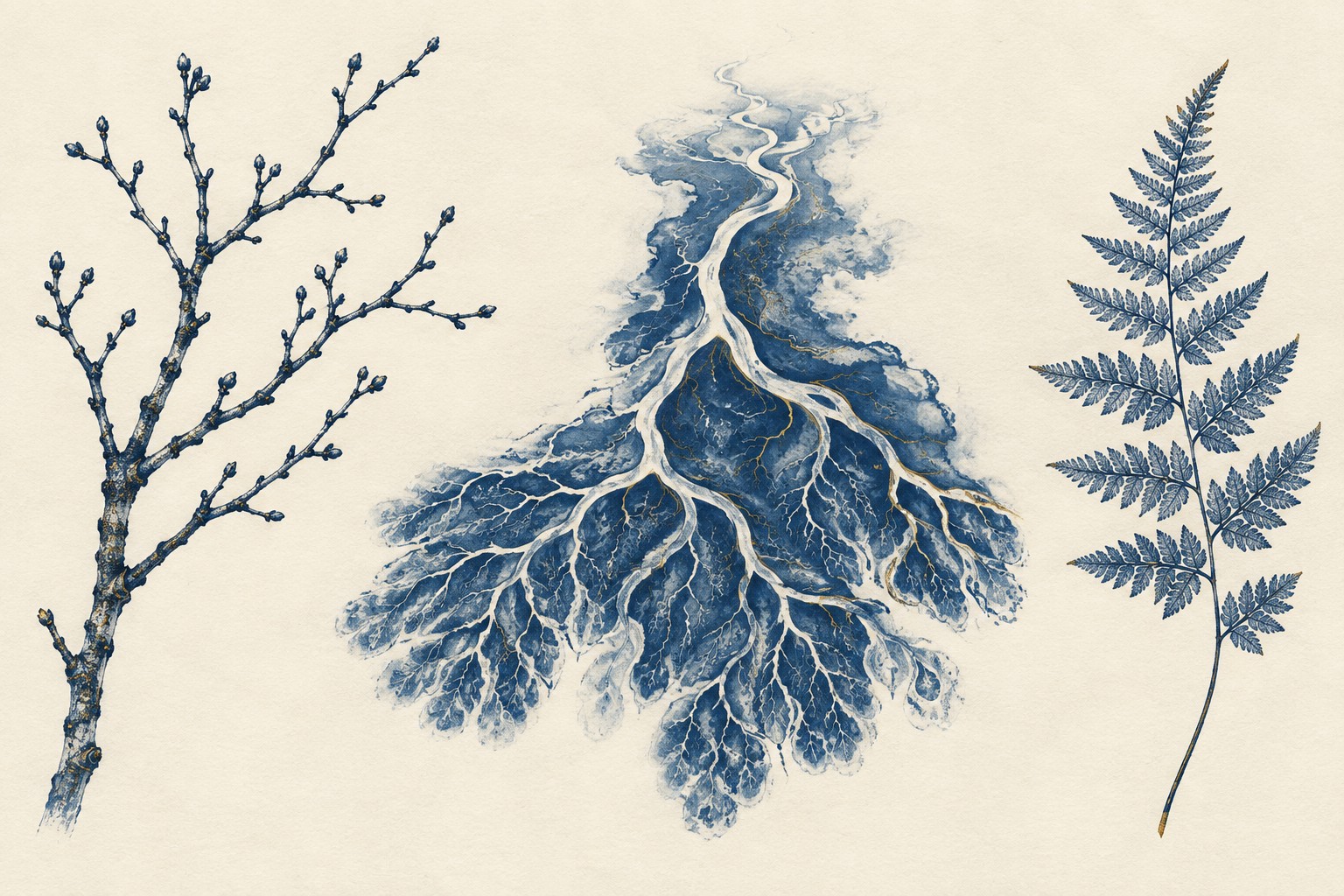
The ocean, the wave, and the crest make this visible. The ocean is the field; the wave is movement; the crest is the temporary form visible enough to be mistaken for a thing. Some crests vanish in seconds; others move at glacial speed as bodies, habits, institutions, species, and worlds. Still they are motion under constraint: flow taking form, then form becoming the channel through which new flow moves.
The coherence test follows:
Separation treated as absolute is illusion.
Unity used to erase difference is that illusion mirrored.
Coherence is what remains when both absolutes collapse.Truth earns trust when it remains answerable as the scale changes.
Show me what remains coherent under zoom.
Look beyond the apparent object.
Ask what persists through transformation.
Under pressure, the test becomes direct:
Coherence survives transformation:
- Under praise and under attack
- In intimacy and in exile
- In community and in solitude
What holds is what the body, the bond, and the consequence can still correct.
You test whether it holds by what happens on an ordinary Tuesday: a charged message, a tired body, praise, misunderstanding, desire, the moment before you answer.
You live it through Field–Resonance–Action (FRA): sensing the conditions around you, noticing what stirs in you and what matters, then choosing one honest action. Its consequences enter the next Field, and the loop begins again.
Over time, small coherent choices accumulate into Fractal Resonance, and what once felt like isolated struggle can reveal itself as pattern moving across scales. This is the alchemy of becoming the Dragon.
The Resonant Self: Five Octaves of One Field
Your body, your emotions, your stories, your archetypal currents, and the silent ground beneath them are not separate territories; they are five octaves of one field. Transformation is the art of retuning one octave so the rest can follow.
Across the Five Energetic Bodies, the axis of integration becomes feelable: fragmentation as noise, coherence as signal. Fragmentation is the static of an old loop, the self living in pieces. Coherence does not require every part to line up or sound the same. Both fragmentation and coherence can appear in each octave.
Living this way gives disturbance a place to move without forcing any part of you into exile.
Static is not fate. Involuntary mental weather, such as an intrusive image, a fear-spike, or a reflex story, is not the same as a pattern you are consciously reinforcing. Repetition, embodiment, and action can consolidate coherence or distortion; the Law of Integration is neutral between them.
The same test applies to feeling. A coherent Dragon does not rise above it; it lets feeling move as signal through the whole field. Grief can be held without becoming identity, anger without becoming attack, joy without becoming inflation, stillness without becoming dissociation. Coherence means each octave can hear the emotion without handing it the throne.
Form Body — Pattern Condensed
Sometimes the Form Body feels like a speaker humming with trauma even when no song is playing. It is the nervous-system ground of experience—breath, posture, sensation, physiology. Breath stays shallow; the body braces; the skin feels unsafe to live inside.
A trauma response can recur without a remembered scene. With enough safety and repetition, it can change. As the breath lengthens, weight may settle more fully through feet, seat, or back; some guarding may ease, allowing movement with more coordination.
Eros Body — Pattern as Charge
In the Eros Body, the pattern is relational voltage: desire, creativity, the pull to meet. When it distorts, it can go numb—or turn urgent enough to drown out the other person, leaving only the ache and the chase.
Intensity becomes a substitute for intimacy.
When the current is met with boundary and repeated care, aliveness can return with defined edges: the capacity to conduct high voltage without burning out, desire moving as a coherent current rather than a scramble for contact.
Soul Body — Pattern as Identity
The Soul Body carries meaning, memory, values, conscience, and the authorship of choice. When it’s distorted, inherited scripts run the day—stories overlapping like radio stations that keep spilling into one another. You feel your chest pulling back at your own misalignment: agreeing outwardly while something in you withdraws.
When the script is met with truth and repeated choice, alignment may become feelable as story, memory, and present choice come into contact. That felt coherence remains answerable to evidence, relationship, and consequence.
Archetypal Body — Pattern as Mythic Form
Here, archetypes rise as recurring action currents linking the personal with the collective—Warrior, Sage, Lover. What you disown gathers in the Shadow; each current also has a Shadow expression, the form it takes when distorted. When a role possesses you, the mask takes over: a martyr pattern says yes with a tight throat and a resentful smile; a tyrant pattern speaks too loud, too fast, as if volume could make reality obey.
Ancient tragedy reruns itself before you notice you’ve been cast.
The same force can become a tool: wearing the mantle without becoming the mask, keeping the current strong enough to serve life but not so strong that it hijacks it.
Void Body — Pattern at the Threshold
The Void Body is your personal capacity for spacious awareness—the inner threshold through which contact with the Void becomes possible within you. When silence is interpreted as threat, the mind fills it with chatter.
When the threat-pattern loosens, there is non-grasping presence: the silence that lets perception clarify, the background stillness that holds all waves in a single field.
A more coherent tone can enter that field through a breath or a chosen act. Sound it often enough, and the neighboring pitches begin to entrain. The old note does not vanish at once. It starts to share a pulse with the one you are willing to keep.
The Resonant Universe: The Entangled Firmament
The self’s architecture mirrors the outer pattern. The Entangled Firmament is the acoustic chamber of relation and resonance—a contemplative model for the medium in which you live.
Nothing happens in isolation: a tone in your voice lands in another body, and you feel the echo in your own chest. Experience rewrites itself in real time—the way one regulated breath changes the next sentence you speak. You are not a spectator; you are inside the field, steering with the next available choice. And within the finitude of a day, a relationship, a single body, there is still infinite nuance.
Physics offers an image: a resonant standing wave, oscillating in place while its pattern holds its shape. In you, that “wave” is coherence across the Five Energetic Bodies: breath low enough to feel, values close enough to touch, action honest enough to stand behind. The field roars and changes, but you remain recognizable to yourself—stable enough to choose, tender enough to be moved. That is coherence under weather.
You are neither outside the field nor dissolved into it. You are a holon within an endless recursion: one local whole of wholes within, nested within larger wholes beyond.
Healing Dissonance: The Alchemical Work
Suffering is often dissonance: a distorted pattern stuck in recursion.
An early abandonment wound in the Soul Body may echo as chronic tension in the Form Body and fear of intimacy in the Eros Body. This is biology, memory, and attachment repeating a pattern rather than moral failure. Fear of closeness needs safety before interpretation.
The Dragon’s practices are methods of conscious retuning. Shadow Work listens for the exiled force inside the loop. Work with the Inner Child returns to the young place where the pattern is still held. Eros work restores honest contact with desire and shame. Each practice enters a different octave, but the aim is the same: introduce a more coherent tone where the old pattern kept rehearsing itself.
The fracture you carried at the start of this journey was never a defect to be erased. If it has become an acoustic hollow, that is because you learned to listen through it without making the wound sovereign. The hollow sings; the harm that carved it was neither good nor necessary for your note to matter.
This was never only about healing. Healing restores enough coherence for the larger work: becoming answerable across scales.
Resonance and Return
In a resonant universe, consequence moves through bodies, trust, and systems. Unity becomes distortion the moment it is used to erase distinction, impact, or repair.
Harm, defended or repeated, thickens into pattern. Before you act, ask: how far will the tone travel, who will feel it first, and can you carry the charge without spilling it? If not, pause—retune, then act.
When you’re clenched, even a careful truth can come out sharp; when you’re settled, a firm no can land without cutting.
No one can control how every note lands. Intention becomes a shield when it is used to dismiss what landed. Name what you did, hear what landed, and let the next act change.
To recognize the pattern is to feel something in your own body answer it. You only recognize the Dragon “out there” because it is already humming “in here.”
Source Pattern: Touching the Void
Where does the original pattern arise? The hinge here is de-iteration: a pattern break, the pause within time where the script loosens. Story, tension, and role drop for a beat, and a fresh input can arrive. It is more contact, not less: a way of returning to the body so the next action comes from a clearer place. The pause belongs to the unfolding too; it interrupts the familiar script without stepping outside the field.
Void Meditation names the deepest threshold here: advanced and optional. Enter it only when readiness, titration, and aftercare are in place. It can return awareness to the Void, felt as the silence beneath the next thought, and open into the Field of Potential: the still, pregnant possibility before the next iteration.
The environmental vigil of Micro-Útiseta offers a gentler echo: listening for signal without projecting stories onto the field. The same humility runs through both practices: first listen for signal, then admit the loop may not be able to heal itself from inside its own momentum.
Gödel showed that a consistent, effectively axiomatized system strong enough for arithmetic contains truths it cannot prove from within its own rules, and that such a system cannot prove its own consistency from inside those rules. Make the net finer and the limit remains. There is still a truth the current rules cannot catch.
A life is not that formal system. What the theorems lend this pause is their shape. The script you are inside can hang together and still be unable to settle the next true move. Introspection keeps circulating the same axioms. De-iteration lets something else into the loop: a breath, a person who was actually in the room, a consequence you would rather not count, the silence between one iteration and the next. The turn is seeded from a wider vantage than the script can certify alone.
Void Meditation does not make you pure; it can retune you toward deeper coherence. You may return to your life refreshed because you have touched the silence between iterations.
Fractal Resonance — The Tuning Fork
Sound the note.
The tuning fork begins with what is present. Let attention travel across the Five Energetic Bodies and notice where reactivity is showing up: a tight jaw in Form, restless anxiety in Eros, a cynical story in Soul.
Notice, too, where you land along the Spectrum of Self-Presence: numb, flooded, blended with the reaction, or able to witness and stay self-led.
Do not fight what you find. If you are numb, flooded, or blended, slow down before acting; step back to grounding until witnessing returns. Then strike a coherent tone: lengthen the spine, let the exhale become longer than the inhale, and recall one core value such as honesty.
Stay with that new frequency for three breaths and notice what shifts. The jaw may soften, the anxiety may settle, the story may quiet.
Meet the loop with awareness, then choose what deserves to be carried forward. Sometimes that choice is to keep the same boundary or agreement again, despite the familiar pressure to abandon it.
Living the Resonance: Dragon Made Flesh
To “be the Dragon” is to let coherence stabilize in you until your presence becomes trustworthy and your signal helps the web settle.
This coherence has a shape. A holon is simultaneously whole and part: boundary and bridge, autonomy and participation. Each cell lives this already inside the larger coherence you call “me.” You feel the same structure whenever you hold your ground in conflict while staying in truthful contact, or stay open to another person’s reality without giving away your own edge.
The Dragon is the holon become conscious of its own nesting, learning to tune the recursion it lives inside.
Mycelium knows this in its own body. Each hypha has a membrane and still belongs to the network: bounded enough to live, permeable enough to exchange, nested enough to belong. That is the Dragon’s mature structure: open to correction without dissolving into compliance or hardening into defence.
The mind resists this because ordinary counting expects parts and wholes to stay neatly separate. Cut a ball of clay and the pieces add back to one ball, smaller in your hands before they are pressed together again. Banach and Tarski found a cut that insults that expectation. Grant the axiom of choice, and a mathematical ball can be divided into finitely many pieces that have no ordinary volume, then reassembled into two balls, each the size of the first. No kitchen, no body, and no workshop can perform it. The pieces are not matter, and they are not parts of a psyche you could name and set on chairs.
Stay with the shock anyway. A bounded form, opened by a cut ordinary hands cannot make, yields two wholes and has lost nothing. Portion did not shrink the whole. The whole did not swallow the portion. Counting still expects one of them to come out smaller. The paradox leaves both intact. A life can belong to a field and remain whole in the same way: both stay full, and ordinary addition is a poor judge of either.
When either side is forgotten, fear starts masquerading as the whole truth. A person forgets the relationship and becomes cutting. A group forgets the person and becomes oppressive. Conflict is often what forgotten belonging feels like.
Partness is humility: you belong to a larger field that sustains you. Wholeness is dignity: you retain boundary and agency within that field.
At a certain point, holding both becomes more than a declaration: breath drops, chest stays open, and yes/no stays plain. The field may still surge, but you stop selling your center for speed. Dragon recursion is the refrain:
Coherence remains corrigible.
I choose to embody it.
Thus I practice coherence—
and let the field answer me here.
The Dragon carries the map without mistaking it for the world. The teaching cannot contain everything reality may reveal or correct. The Fool meets that uncertainty without paralysis: it keeps the Dragon open, and the Dragon gives its openness body, direction, and consequence.
The measure, then, is whether return becomes trustworthy, even without flawless mastery.
If each life is a local expression of a larger living weave, then the way you tend your own ground matters to the whole.
Miðgarður: The Human Enclosure
The Icelandic name for the human world is Miðgarður, from Old Norse Miðgarðr, a name carrying both Middle-earth and middle enclosure. In Gylfaginning, the gods make a stronghold for humankind from Ymir’s brows. The image holds both the boundary and the inhabited world that boundary makes possible.1
The myth carries an older intuition: human life unfolds inside a bounded, inhabitable domain nested within an order larger than human perception can hold.
The enclosure does not make Miðgarður unreal. It gives the world enough contour for body, relationship, choice, and consequence. As a symbolic correspondence, Yggdrasil is the wider architecture; Miðgarður is the human rendering held within it.
The body is a smaller enclosure within that enclosure: a finite surface through which the wider pattern feels, remembers, chooses, and returns in one place. Identity takes root here: this life, this history, this promise to keep. The other remains other, even where separation softens. Encounter needs that difference.
The Dragon does not awaken to escape the garden. It awakens to inhabit it lucidly.
Holography offers one last image for this relationship between field and finite form: pattern held across a field, not locked in one privileged point.2 Without a finite surface to hold interference, no image can return.
The Holographic Gardener tends this ground. Not the whole cosmos. Not another person’s soul. The garðr entrusted to one life: body, bond, work, boundary, and the local pattern one’s choices keep reinforcing. Faithful tending gives the wider field one place where other lives can hear their own signal more clearly.
Your life is the instrument; attention is the bow. The work is to play true, so your presence rings clearly through the field.
When two people remain in the room, their rhythms can entrain. Breath, pace, and tone settle toward a shared pulse, and each instrument keeps its timbre. Love doesn’t need possession to feel real. Fidelity is playing your note again, and keeping the agreement that lets the other player stay audible. You do not harmonize by becoming the same sound.
When signal travels clearly, aliveness returns colour to the ordinary world.
The Spiral Path never ends.
Iteration continues.
This is the Law of Integration:
What is reinforced becomes integrated. What is integrated reinforces itself.
In Zoroastrian ethical terms, the same law compounds both poles. Reinforced truth deepens into Asha, right order becoming lived character. Reinforced distortion deepens into Druj, misalignment rehearsed until it begins to organize character.
This is virtue at the level of pattern: coherence repeated until it becomes character. Vice is the same law turned toward distortion, a rehearsed loop, not an essence.
The law turns both ways: you are the recursion within the holographic field. What you reinforce through the life you live, the field reinforces through the pattern that is you, because there is no outside position from which to tend it.
The repetitions that carry coherence outward also reorganize the recursion inward. The Holographic Gardener is not cultivating something separate. The Holographic Gardener is the recursion remembering itself through the integrity of its own acts.
Hold both your partness and your wholeness.
Because a being is finite:
it needs boundaries.
Because it is relational:
it needs ethics.
Because it is embodied:
it needs capacity.
Because perception is partial:
it needs humility.
Because patterns recur:
it needs integration.
Because recurrence is not automatically good:
it needs discernment.
Because the world exceeds every map:
it needs openness.
And because incompleteness is permanent:
it must eventually stop trying to finish itself and live.
No finite identity exhausts its source. No appeal to source cancels a finite life.
The contour remains open. The life is here to be lived.
From Pattern to Horizon
What follows widens the view.
These final reflections are not here to hand you another structure to
obey.
They are here for the moment when lived practice begins to ask larger
questions again:
How does this path meet a changing culture?
What happens when intelligence itself becomes a mirror?
What kind of cosmos does this way of living imply?
Enter these chambers the way you would look at a distant
mountain:
with wonder,
with discernment,
and without needing to move there to know where home is.
The horizon opens.
Keep your tether.
Old Norse Miðgarðr is glossed as both “middle-earth” and “middle enclosure”; in Gylfaginning, the gods make the enclosing stronghold for humankind from Ymir’s brows. See Snorri Sturluson, Edda: Prologue and Gylfaginning, ed. Anthony Faulkes, 2nd ed. (London: Viking Society for Northern Research, 2005), 12, 172; and Edda: Skáldskaparmál, 2: Glossary and Index of Names, ed. Anthony Faulkes (London: Viking Society for Northern Research, 1998), s.v. “miðgarðr.” Modern Icelandic uses Miðgarður.↩︎
Dennis Gabor’s 1968 temporal-recall model and Karl H. Pribram’s holonomic brain work used holography to think about distributed memory and pattern retrieval. See Gabor, Holographic Model of Temporal Recall, Nature 217, 584 (1968); Pribram, Languages of the Brain (1971); and Karl H. Pribram, M. Nuwer, and R. J. Baron, The holographic hypothesis of memory structure in brain function and perception (1973).↩︎