Part II
Chapter 10: Graphs of Reality
Estimated reading time: 9 min
“The universe is not just the position of all its Democritean atoms. It is also the net of information that all systems have about one another.”1
— Carlo Rovelli
The Entangled Firmament has poetic force and a structure the mind can trace. A graph gives us one language for that structure: reality seen as patterned process rather than static objects.
Seen this way, hidden architecture comes into view: relations learning how to repeat, not a fate fixed in advance. Computation is useful here as a lived metaphor for how each choice teaches the next moment what it can become.
The same grammar appears wherever living work becomes repeatable: intuition becomes language, language becomes structure, structure becomes process, and process reshapes the next intuition. Flow becomes form; form shapes flow; the loop learns.
Physics speaks in fields and symmetries, biology in regulation and metabolism, psychology in meaning and narrative. Graphs let us trace relations across these different domains.
The Geometry of Connection: Nodes and Edges
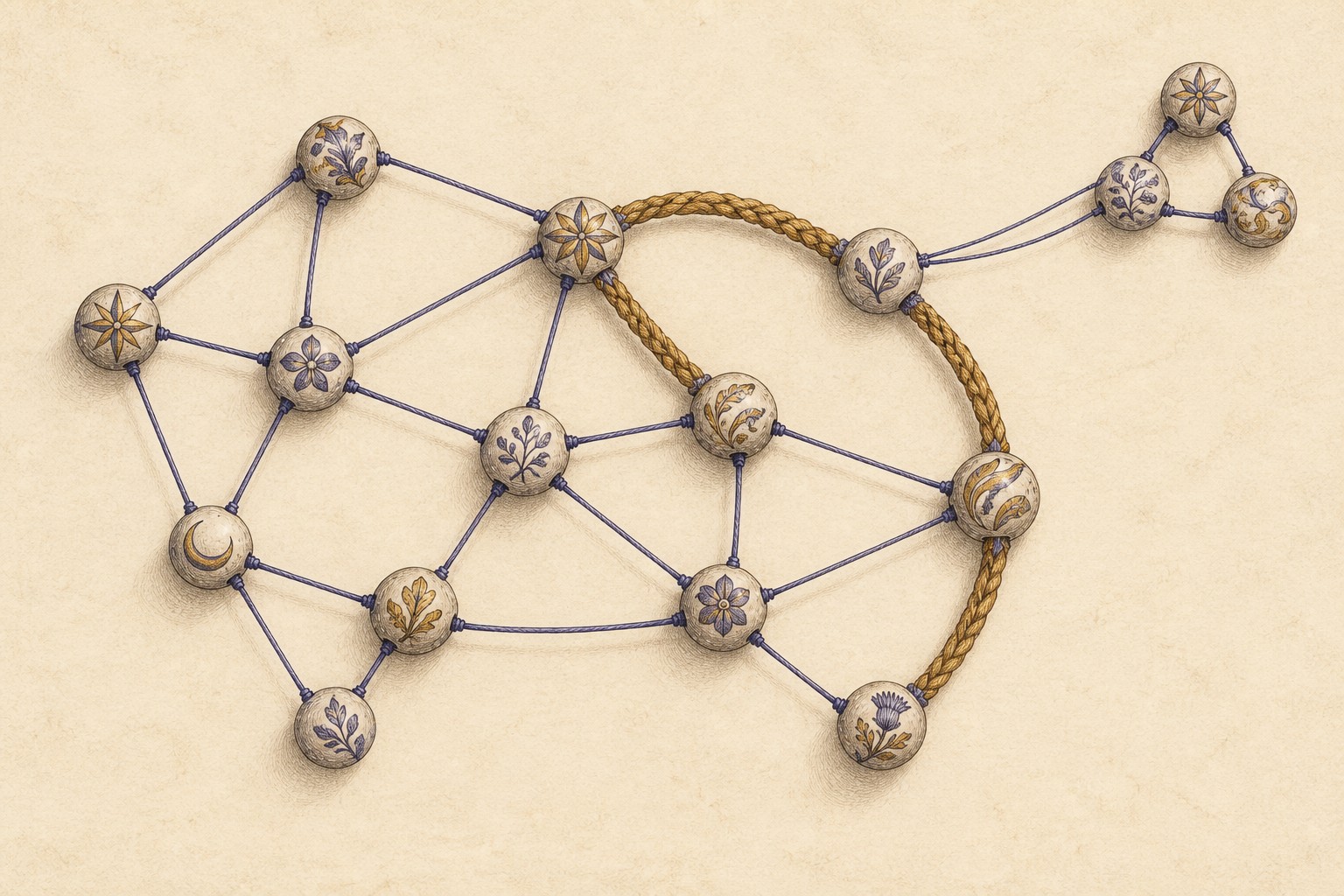
If the Entangled Firmament names the living field, a graph gives us one map of its relations. In complexity science, a graph is simple: nodes (points) connected by edges (lines).
- The nodes are the “things”: you, a sensation, a specific memory, a star.
- The edges are the relations: gravity, trust, a trigger, a shared history.
Not all edges are visible. Some belong to the Dark Entangled—the unseen web of ancestry, culture, and history that feeds input into your nodes before you are even aware.
You can feel those hidden edges in the way a room changes your body before thought can explain why.
In this model of reinforcement, edges carry weight. Some are faint lines; others are thick, well-worn tracks. The image gives the Law of Integration a graphical form: “What is reinforced becomes integrated. What is integrated reinforces itself.” Repeated reinforcement thickens the line. Over time, old routes become defaults while less-travelled alternatives remain thin until life gives them enough repetition to hold.
If we focus on the node (“I am sad”), the wider pattern stays hidden. The Dragon looks at the graph instead: “What edges are feeding this node?” Change enters less by attempting to remove or bypass the node than by altering the relations that keep feeding it.
At human scale, metacognition is node-level awareness: noticing thought, impulse, story, or script while it is running. Systems thinking is edge-level awareness: noticing the relational structure pressing on that node. One says, “I am reacting.” The other asks, “What field is recruiting this reaction?” The Dragon needs both. A watched reaction can still obey an unseen edge.
Trauma offers one human-scale example. A fragmented memory or survival pattern is not merely a disconnected dot. It can behave like a small subgraph, strongly connected internally by threat, shame, body memory, and old belief, while its edges to present safety remain thin. Healing does not delete that pocket; it strengthens those present-time edges through repeated resourced contact, giving the isolated territory more ways to join the larger system.
Graphically, this is integration by resourcing: not forcing a wounded part to change, but bringing present-time safety into contact with old survival territory gently enough for new edges to form.
From Trees to Webs
We often organize experience through lists or trees. Lists keep sequence visible; trees trace origins and hierarchy. A graph asks a different question: what keeps feeding the pattern you are inside? A list asks what comes next. A tree asks where it came from. A graph asks what keeps making it recur.
Lists and trees are particular graph structures. Each makes some relations easier to see; the wider graph lets us follow connections that sequence or hierarchy leaves out.
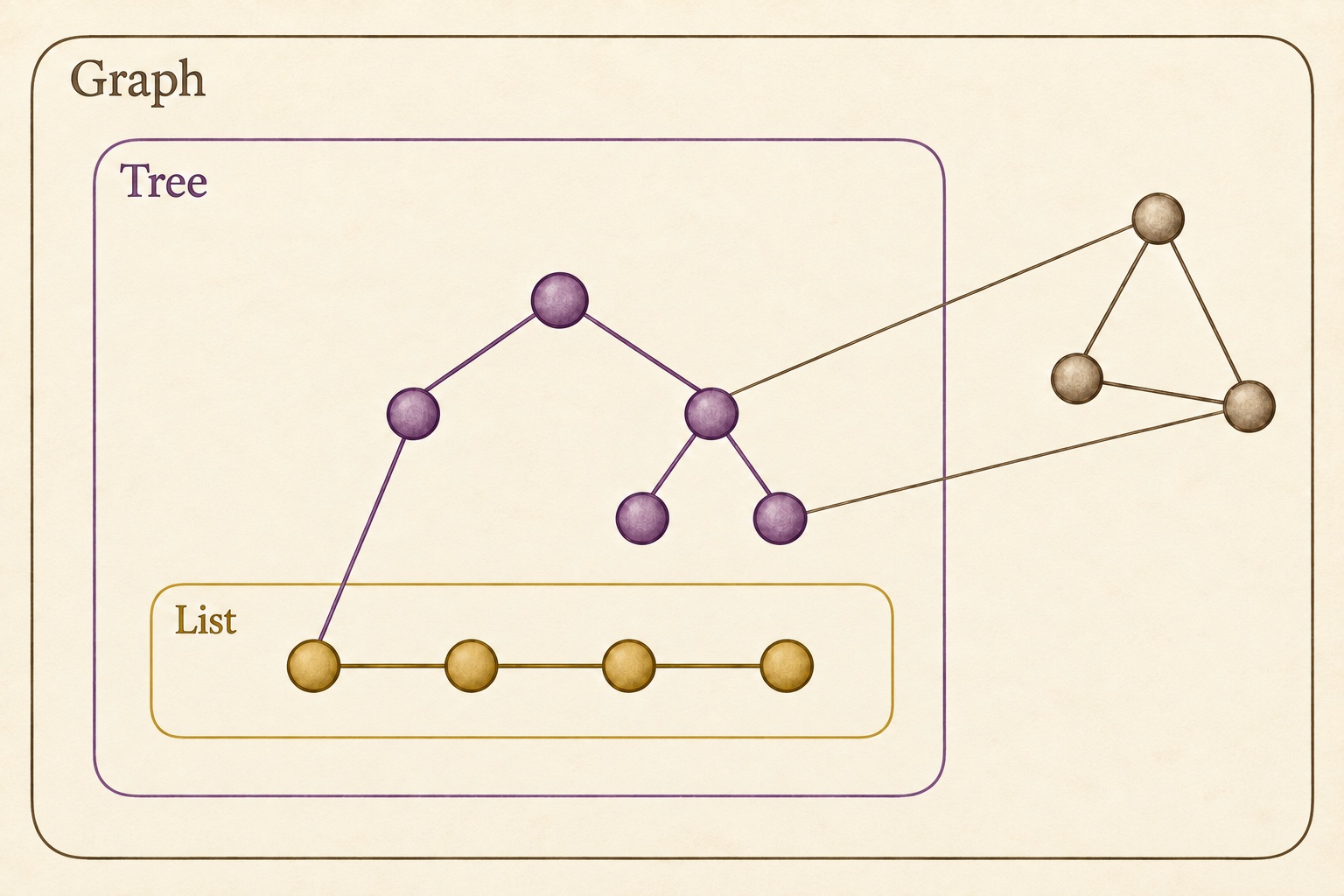
A root may explain origin. A graph can trace maintenance: the living relations that keep an old answer running. It still needs an account of what sustains or changes those relations.
When tree-thinking becomes exclusive, we look for the cause: “I am anxious because my mother was critical.” We dig for the root, hoping to cut it.
The psyche also behaves as a network.
In a network, an origin can remain important without functioning as the single cause of what happens now. There are loops. One might sound like this: “I feel anxious → I withdraw → my partner feels lonely → they criticize → I feel more anxious.”
The pattern has a history, but once the cycle is running, no one moment is its sole beginning. Chaos theory offers a related image in the Strange Attractor: trajectories stay within a patterned region without settling into a repeating cycle. The relational loop has its own sustaining conditions—expectations, responses, and reinforced connections that keep drawing the encounter through familiar grooves.
Here, graph-thinking changes the question: once the loop becomes visible, explanation no longer has to stop at a single root. The pattern becomes legible as a live circuit rather than a fixed verdict. False closure forms when the wound has been named, but the graph has stopped updating.
Every graph leaves relations untraced, and some changes become legible only through further traversal. The map must leave room for reality to answer back.
Shift one edge in a living system and the change does not stay private; it alters the pattern others are meeting too.
Sometimes the most consequential shift comes from rerouting an edge rather than breaking it.
Indirection and Triangulation
In a graph, adding a node between two points introduces indirection. Structurally, that is neutral. It can widen a system’s freedom: another route for energy to travel, another context that helps a rigid dyad breathe, another way a stuck loop can open.
A bond can benefit from that widening. A shared practice, a wider community, or a wise third point may bring perspective without replacing direct contact.
The difference is whether the third point deepens relation or begins to mediate worth. When recognition starts passing through an outside standard, meeting gives way to measurement. Comparison enters the bond, and triangulation takes structural form.
The body may register the shift first: the jaw hardens, the stomach drops, attention starts scanning for rank instead of meeting the person in front of you.
Reality as Computation
If the graph is the structure, computation is the pulse that carries it forward.
In this lens, computation is simply the processing of information to carry the next state forward. You can picture each moment as a calculation: input + rule = output. Here, computation names a live current: one relation generating the next.
Your current state—jaw tight or breath easy, supported or depleted—interacts with your habits or choices (rule) to produce the next state (output).
This is why healing cannot remain an idea. The next moment is computed through the state you bring and through the edges already pressing on it: another person, the room, a history you did not choose.
The Standing Wave Metaphor
If you are constantly being recomputed, why do you feel solid?
Physics offers the image of a standing wave—a pattern formed by interference that can look still while vibration continues within it. Picture a self as a standing wave stabilized by loops. Habits, memories, and reflexes are the recursive cycles that keep the wave “standing.” When you try to change a long-standing pattern, you are altering the frequency of a wave while the system is still in motion, which is why transformation requires patience with momentum.
The question is how that loop is being carried: by survival momentum alone, or by conscious participation in the pattern.
- The Serpent names the raw, unintegrated life-force moving through the old loop, often carried by survival reflexes and whatever has already been reinforced.
- The Dragon names the conscious stance that can carry the loop differently, stabilizing a pattern with more integrity and care.
When the stance shifts, the rule shifts with it, and the next moment is no longer computed in quite the same way.
The Ruliad: An Infinite Library
Where do the possibilities come from? We borrow Stephen Wolfram’s concept of the Ruliad2 as one speculative way of imagining the rule-space through which possibility becomes traversable.
It gives possibility a structure: rules generate paths, paths reveal consequence, and no observer stands outside the whole library.
Yggdrasil, the World Tree, carries a mythic version of the same orientation. Its branches and roots bind Asgard, Midgard, the underworld, sacred wells, and unseen sources into one living order: hidden architecture, branching consequence, and no privileged perch outside the tree.
Together, the images teach the eye to think in paths and relations inside a wider rule-space. The tree is a path through branching consequence, not the whole graph.
Change still comes through embodied iteration: living a different rule, then letting repetition teach the graph.
The library may be infinite, but you are a finite observer tracing one specific path through it. You cannot live every life; the work is tending the specific, bounded curve of your own becoming.
Work on emergent organization and intrinsic computation3 studies how structure and computation can arise within dynamical systems. Imagine a loop testing its own descriptions as new forms appear, with no final view from nowhere.
That image rhymes with awareness noticing itself. The Dragon examines and reshapes its path through the larger process. The work is traversal: walking the curve until the finite path reveals more of its structure.
Computational Irreducibility: The End of Shortcuts
Computational Irreducibility begins there: some paths can only be known by walking them. The principle is simple: traversal is not a delay before understanding, but part of how the pattern becomes knowable.
In some simple systems, a formula predicts the end. In computationally irreducible systems, there may be no shortcut substantially simpler than carrying out the computation itself.
Some human paths become knowable only through the steps that shape them.
The steps are not a hallway to the result; the steps are the shaping. You do not change the graph by skipping grief or accepting a finished answer from outside. You change it by running another iteration.
This is why the Spiral Path is recursive. You walk the territory to etch the change into your nervous system. The pull of a familiar pattern is carried through the relations that keep it active. You shift it by running new iterations—feeling the pull, choosing a different edge, and letting repetition change the graph.
Traversal
Seeing reality as a graph gives your choices back their gravity. You are a participating node in the Firmament; each conscious shift changes the next edge the pattern is likely to take.
Understanding can reveal a route through the library of potential; living it is how the pattern changes. The path becomes visible through contact, error, rerouting, and return. And when the pattern grows too dense to solve from within, another threshold appears: not more control, but a deeper meeting with limit.
Carlo Rovelli, Relative Information at the Foundation of Physics (2013).↩︎
For Wolfram’s own introduction to the idea, see Stephen Wolfram, The Concept of the Ruliad (2021).↩︎
For a nearby scientific conversation about emergent organization and intrinsic computation, see Adam T. Rupe and James P. Crutchfield, On Principles of Emergent Organization (2023). This is not a direct source for the chapter’s metaphor.↩︎