Part II
Chapter 11: The Limits of Logic
Estimated reading time: 11 min
“This statement is unprovable.”
— After Kurt Gödel
Can reason build a map with nothing left outside it? Mathematics gives that hope a precise test: whether a set of exact rules can prove every truth it can express.
“This statement is unprovable” resembles a linguistic paradox like “This sentence is false.” But that classic loop relies on semantics—on what the sentence means.
Gödel’s result differs. Through an arithmetical encoding (Gödel numbering), he showed how a consistent, effectively axiomatized formal system strong enough for arithmetic can represent statements about its own proofs.1
If such a system could prove a statement that effectively says “I am not provable here,” it would undermine its own consistency. If the system is consistent, the statement remains unprovable from within.
It is a proven crack in the dream of a complete formal account: a limit reason discovers within its own most rigorous tools.
In a lived paradox, two real truths seem to pull against each other—and yet can both belong once context or timing widens.
Contradiction is when two claims cannot both be true within the same frame; one or both need checking, repair, or a new frame.
Calling a contradiction paradox does not resolve it.
The question sharpens when limit stops being theory and enters a life.
The young monk sits in the early morning garden, a letter in their lap. Their sibling writes: “Father is ill. The family needs you home.”
The abbot has approved a five-year retreat—the deepening the monk has yearned for since ordination.
To return now is to honour filial duty, to tend the web of family that held them before vows. To stay is to honour spiritual commitment, to complete what was begun with the sangha’s blessing.
Both paths are acts of love. Both paths involve loss. The monk feels the paradox settle in their ribs—not as confusion, but as truth. Their breath slows. The morning air is cool against their palms.
The bell rings for morning practice. The letter remains unanswered.
Reason can clarify the choice without making either loss disappear. What remains is the practice of holding both, breathing through both, and choosing while both loves still matter.
Beyond the Reach of Reason
It’s natural to seek certainty.
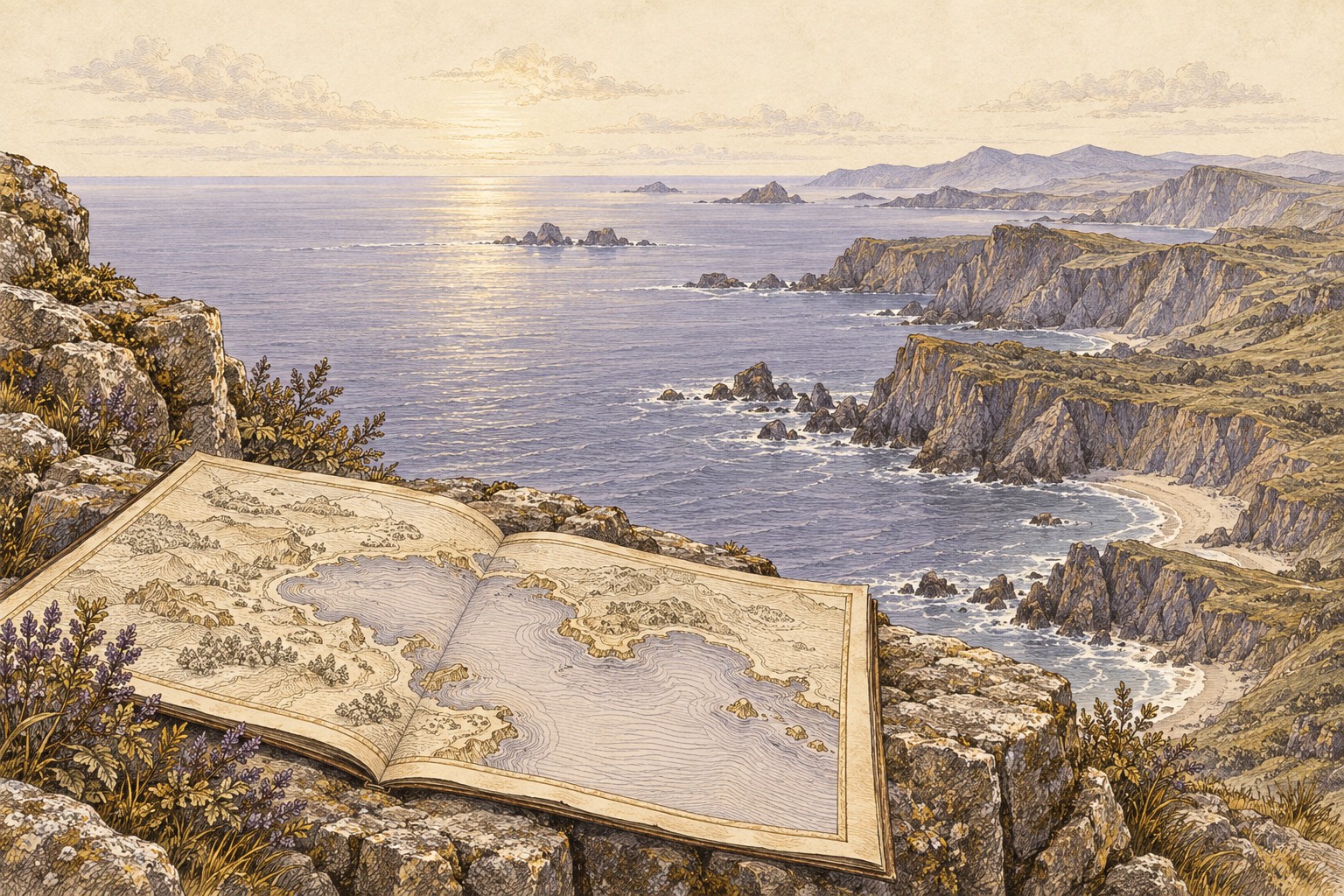
You build maps to find your way, making meaning from the story of your life and from what you have suffered and striven for.
And yet, like all who seek understanding, you eventually meet the edge of every framework: the place where language falters, maps blur, and tidy explanations collapse under the weight of lived experience.
Norse myth carries an older version of this threshold: Odin at Mimir’s Well. He did not ask for wisdom without cost; he paid with an eye.
When we crave certainty, we want to map the territory without getting wet. But here, to see further, you give up denial: the fantasy that your map can contain the whole. The trade is the surrender of certainty, not the abandonment of reason.
Some experiences—deep wounds, mysterious longings, moments of inexplicable clarity—resist tidy explanation. They may remain real and consequential even when the frame you have cannot yet account for them.
And so, the Dragon meets you here as a guide through paradox.
It teaches a sterner wisdom: know the map, honour its edge, and stop trying to make the unsolved parts of yourself perform as problems.
Reason remains indispensable. So does knowing where its present reach ends.
A Formal Contradiction: Russell’s Paradox
Before Gödel revealed limits within powerful formal systems, Bertrand Russell exposed a more immediate fracture in the foundations mathematicians were trying to secure.
Early set theory seemed to offer a language broad enough to gather mathematical objects into well-defined collections. Then Russell asked what happens if we consider “the set of all sets that do not contain themselves.”
Call this troublesome set R. Does R contain itself?
- If R contains itself, then by definition it should not belong to R.
- If R does not contain itself, then it satisfies the condition for belonging to R—and therefore must contain itself.
Either answer produces contradiction.
The problem was not that mathematics had encountered ineffable mystery. Unrestricted set formation permitted a contradictory definition. Formal mathematics responded by restricting what could count as a set.
But even a coherent formal system raises another question: can sufficiently powerful rules capture every mathematical truth available within their domain?
That is where Gödel enters.
Formal vs. Natural Language
Russell’s paradox reveals one strength of formal systems: when unrestricted set formation produces a contradiction, the rules can be tightened. A formal language aims to make meaning stable by restricting what counts as a valid expression.
Natural human language cannot work entirely that way. Meaning depends on context, speaker, timing, history, tone, and the body that receives the words.
Formal systems preserve coherence partly by excluding certain ambiguities. Human lives often have to remain meaningful while ambiguity stays present.
Healing works in that second territory. An experience does not arrive through syntax alone; it is carried through relation, memory, sensation, consequence, and changing context.
Russell’s construction is a contradiction that forces revision of the formal rules. Human paradox is different: two valid obligations can remain real even when every available choice carries loss.
Trying to force such tension into a neat binary answer can tighten the knot. Sometimes discernment means remaining with both truths long enough for the next honest action to become visible.
Gödel’s Theorems
The two theorems mark different limits: what a formal system can prove, and what it can establish about its own consistency.
1. First Incompleteness Theorem: Truths That Outrun Proof
Gödel’s first theorem states that any consistent, effectively axiomatized formal system strong enough to express arithmetic contains statements that are true in the intended interpretation yet unprovable within that system.
The metaphor turns inward: what in your experience becomes intelligible only when you reconsider the assumptions you began with?
Language is not a formal system in Gödel’s sense, yet it too can fail to hold your deepest experiences.
If a system cannot prove every truth, can it at least establish that its own rules are consistent?
2. Second Incompleteness Theorem: The Limits of Self-Validation
Under the standard conditions, Gödel’s second theorem goes one step further: such a consistent formal system cannot prove its own consistency from within.
The human question this opens is narrower: introspection alone does not always show you the whole pattern you are living.
Sometimes another vantage clarifies what your private loop cannot yet see: a relationship, a landscape, a myth, a consequence, a wider field of relation.
The larger web of the Entangled Firmament does not solve that uncertainty. It gives it proportion, showing that self-knowledge is often widened by contact rather than secured in isolation.
The Crack in Everything
New axioms can bring a formerly unprovable truth within reach. Yet any stronger system that still meets Gödel’s conditions remains incomplete. The net grows finer; there is still something it cannot catch.2
Gödel’s theorems establish a limit within formal mathematics. They do not tell us what lies beyond that limit, nor do they prove that reality itself is structured in the same way.
What they offer this path is narrower and, for that reason, more useful: a rigorous encounter with the fact that even an extraordinarily powerful system can meet an edge from within its own structure.
The metaphysical question begins after that result. Does reality itself exceed every finite account made of it? The Entangled Firmament keeps that possibility open without asking mathematics to answer it.
The Dragon does not seal the opening with another certainty. It learns to breathe at the edge, where reason has done its work and awe, humility, and the sacred can remain possible without masquerading as proof.
Lenses at the Edge of Logic
The Dark Entangled names the cosmological unknown: the mycelial web of influences not yet visible, and the dormant seed of what has not yet emerged. The unknown exceeds the personal Shadow.
Science advances by meeting the unknown, but the kind of limit matters: a theory may need revision, observation may lack contact, and precise laws may still resist prediction.
At the Planck scale, our current account of spacetime approaches one of its deepest theoretical limits. Quantum effects of gravity are expected to require a deeper description of spacetime itself.3 Looking closer asks us to reconsider the mesh through which we look.
At the other end of scale, a cosmic event horizon marks a limit of contact. If expansion continues as predicted by the cosmological-constant model, light emitted now from sufficiently distant galaxies will never reach us.4 Our theories can describe those regions even when their present events remain beyond our observation. The world can be larger than any observer’s reach.
One edge asks for a deeper theory. The other limits contact even if the theory is right.
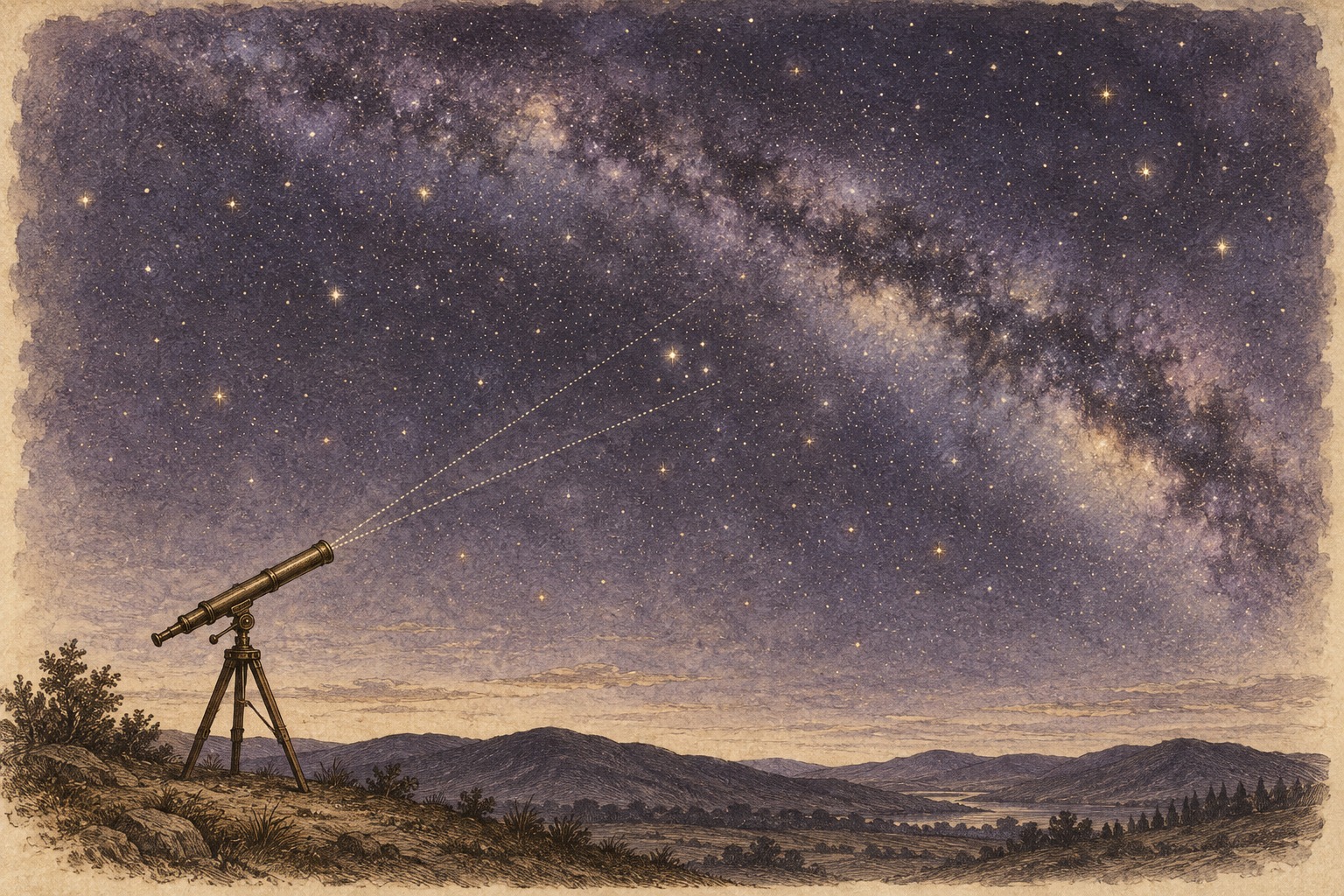
A third kind of limit appears when the rules stay exact and the future still will not sit still.
In an idealized two-body case, Newton’s laws give closed-form predictions for a pair in orbit, such as a planet around a star. Add a third body and the general problem no longer has one universal closed-form solution. Some configurations remain stable or periodic; others become chaotic.
Poincaré showed how this arises: the laws remain precise, yet sensitive dependence can sharply limit reliable long-term prediction.
An inner life under stress can work the same way. Protector, critic, longing, and fear may organize a pattern without offering a forecast. A breath, a new fact, a remembered value can re-weight the whole field. A perfect prediction is unnecessary. What matters is a way to return, listen, and choose.
You cannot solve yourself into wholeness. You can only participate in your own becoming. Clamp down hard enough on what has not yet been understood, and contact narrows until something gives.
Intuition, body, dream, and symbol can enter there as further contact—material that reason may then help test, interpret, and place.
Meeting the Inner Unknowable
When the intellect reaches the edge of what it can establish and the heart reaches what it cannot resolve, Zen koans, Taoist paradox, and apophatic prayer point toward what can be met but not captured.
A living question then changes character. It no longer asks to be solved neatly; it asks to be carried without collapse. The monk’s letter remains one image of that threshold: a truth that cannot be flattened into certainty without losing part of itself. Not-knowing becomes a form of contact.
The same shift can happen through scale. A fractal, a spiral shell, or the night sky can open finite form into felt vastness. Infinity stops being a concept and becomes a pressure on the edges of thought: awe, humility, and the sense that one human life may hold more depth than any tidy explanation can secure.
Sometimes the unknown arrives even closer than that. It appears as a bodily fact before it becomes an idea: a tightness in the chest, a hollowness in the stomach, static in the hands, the sense that one answer has only opened a deeper question. In those moments the Dark Entangled no longer reads as darkness to fear, but as what the map has yet to reveal, keeping explanation open to discovery.
Where in your experience have you met what outruns explanation, and where do you still resist the paradox it brings? Let that question live in you as a pressure at the edge of certainty, not as a problem to solve.
The Seam Between Knowing and Mystery
The threshold stays embodied. Mystery does not become an answer; it becomes something you can remain in contact with—in the breath, the belly, the voice, and the next move you make in the room.
The Dragon does not solve this paradox. It walks between knowledge and mystery without collapsing either into the other. It uses reason fully—to clarify claims, check distortions, test the frame—then lets it stop where it stops.
The Divine is not another object placed beyond the present limit of science. It is the name I give to reality’s inexhaustible depth: what no finite description, experience, or map could finally exhaust.
That is a metaphysical wager, not a consequence of Gödel’s theorems. Gödel gives us something more disciplined: a precise demonstration that certain formal systems encounter limits to what they can establish from within themselves. The resonance matters to me, but the distinction matters more.
The Dragon’s craft is to remain at that seam without forcing either side to become the other: reason used fully, mystery left genuinely open, and whatever truth gathers there required eventually to answer a life.
See Kurt Gödel, Über formal unentscheidbare Sätze der Principia Mathematica und verwandter Systeme I, Monatshefte für Mathematik und Physik 38, 173–198 (1931). For the strengthening from ω-consistency to ordinary consistency, see J. Barkley Rosser, Extensions of Some Theorems of Gödel and Church, Journal of Symbolic Logic 1(3), 87–91 (1936).↩︎
See Kurt Gödel, Über formal unentscheidbare Sätze der Principia Mathematica und verwandter Systeme I, Monatshefte für Mathematik und Physik 38, 173–198 (1931). For the strengthening from ω-consistency to ordinary consistency, see J. Barkley Rosser, Extensions of Some Theorems of Gödel and Church, Journal of Symbolic Logic 1(3), 87–91 (1936).↩︎
The Planck length is roughly metres. See the Max Planck Institute for Gravitational Physics, Planck length, for this characteristic scale of quantum gravity.↩︎
An event horizon depends on the universe’s future expansion. The particle horizon concerns signals that could have reached us so far. See Tamara M. Davis and Charles H. Lineweaver, Expanding Confusion: Common Misconceptions of Cosmological Horizons and the Superluminal Expansion of the Universe (2004), §2 and Appendix A.↩︎