Part II
Chapter 7: Dynamic Emergence
Estimated reading time: 14 min
“The only way to make sense out of change is to plunge into it, move with it, and join the dance.”
— Alan Watts
The Rhythm of Becoming
Dynamic Emergence names reality’s native pulse: ceaseless becoming, as interaction, conditions, and history give rise to the next pattern. The same logic can be seen in a nervous system finding a new response, an ecosystem reorganizing after disruption, or a culture shifting under pressure.
Reality meets us as patterned motion—channels carved by past flows, still carrying turns no planner could have foreseen.
Imagine this as a living current: shaped by history, brimming with possibility.
In a familiar argument, you pause and hear the tremor beneath your partner’s words. “I want to understand before I react,” you say. Their shoulders drop a fraction. The disagreement remains, but the next words arrive into an exchange that has already changed.
From Chaos to Novel Patterns
Reality behaves less like a fixed design and more like living weather: conditions meet, and unforeseen patterns arise without a planner specifying the result. They can organize or destabilize, nourish or destroy. Emergence itself carries no moral direction.
One distinction keeps this lens disciplined. Personal Shadow can distort perception and choice; unpredictability also arises from conditions far beyond the self. Much of life’s surprise comes from the Dark Entangled—unseen conditions, histories, and latent potentials moving through larger systems. Discernment begins with owning personal distortion without claiming the whole field.
Defining Dynamic Emergence
Dynamic emergence names the ongoing process by which interaction, conditions, and history give rise to patterns, behaviours, structures, and breakdowns that the parts considered alone do not plainly predict. It does not require greater complexity, coherence, or goodness. Interacting cells can form coordinated tissues; relationships can generate meaning or rupture. Consciousness is often approached through the same lens, though how subjective experience arises remains unsettled.
Dynamic emergence is not creation from nowhere. Each level inherits a structured possibility-space from the level beneath it. Interaction, selection, feedback, and stabilization — and processes we may not yet understand — suppress some relations, amplify others, and let some reappear as effective structure at the new scale. The emergent form need not resemble its substrate pictorially. It may rhyme with it structurally. Once that form stabilizes, it becomes part of the substrate for what emerges next. Some of what is possible there was not available as an effective possibility in the level beneath.
Dynamic emergence is not a finished achievement. Yesterday’s turn becomes today’s condition, shaping what can happen next. A sculpture may display emergence in static form. Dynamic emergence is closer to an ecosystem or a developing mind, continually responding and generating possibility from within its own movement.
Shift timing, pressure, relation, or resource, and the next path can change slowly or suddenly. In human life this appears as reorganization: a charge resolves differently, a habit loses its inevitability, a response becomes available that was unavailable moments before. Emergence can be observed. It can also be recognized from within and answered with choice.
Complexity and Chaos
Science offers models of this rhythm. Two lenses—complexity theory and chaos theory—illuminate transformation, sensitive dependence, and self-organization.
How Pattern Becomes Pulse
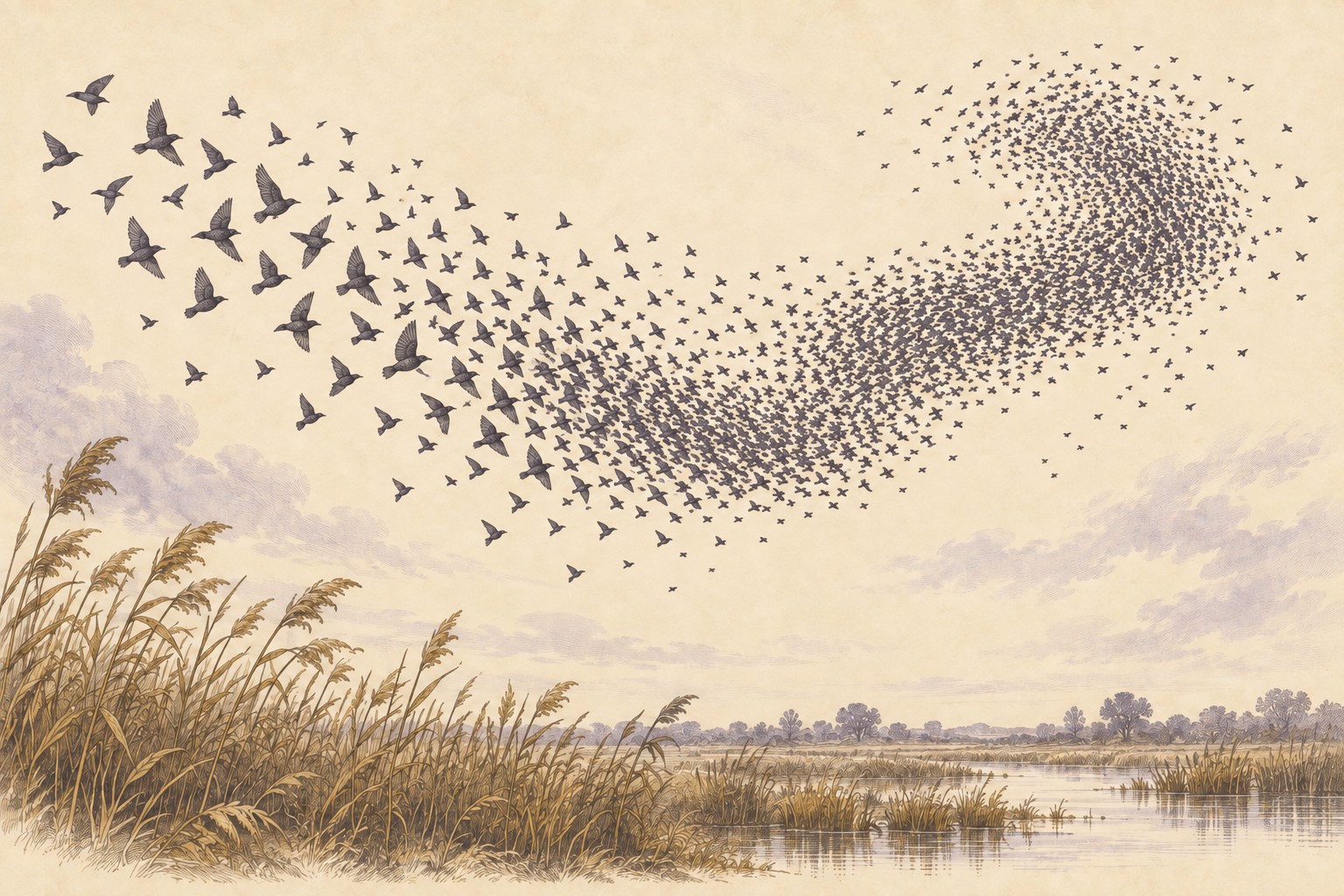
In complexity theory, order can arise from simple parts interacting under local rules: no central controller, no blueprint, just relation birthing form.
The turn of the flock still belongs to no single bird. Each answers only what is near it. None of them held the shape they made together. That shape is not nothing, and it is not another bird.
Denis Noble’s work on the heart sharpens the same point. Pacemaker rhythm is not handed down from a single master cell; it emerges through physiological networks that constrain, reinforce, and excite one another.1 Biological relativity gives the broader principle: no level owns causation in advance. Cardiac rhythm self-excites through relation: molecule, cell, tissue, organ, and organism shape the beat together until pattern becomes pulse.
The brain offers another, more contested mirror. Billions of neurons participate in interdependent webs, and many scientific accounts treat consciousness as an emergent activity of the living system. How subjective experience arises remains unsettled.
Pattern Without a Planner
Self-organization is the spontaneous arising of order through local interaction without a central controller. Boundary conditions, environmental coupling, and energy still shape what can arise; no external architect needs to direct each move.
Snowflakes crystallize into sixfold symmetry, ant colonies build complex social systems from simple behaviours, and ecosystems braid dense food webs through interaction.
Coherence without a planner is one possible outcome of emergence. Incoherence, collapse, and destructive stability can emerge as well.
The Spiral Learns to Remember
Before life could remember, chemistry had to persist. Molecules formed, broke apart, and sometimes helped reactions recur. Yet recurrence alone does not explain heredity, and the origins of life remain unsettled. DNA need not have been the first system to carry a pattern forward; earlier forms of inheritance may have used different molecules and mechanisms.
DNA nevertheless shows one durable arrangement. Complementarity gives it memory and constraint: each strand limits what can pair with it, providing a template for copying. Watson and Crick saw that implication in the structure itself; Meselson and Stahl later showed in bacteria that replication is semiconservative, with each daughter molecule retaining one parental strand.23
The copy is stable enough to preserve a lineage and open enough for mutation and recombination to introduce variation. Selection has no foresight and no image of the creature it is trying to make.
Still, recurrence with variation changed what matter could do. A pattern could outlast the particular molecules carrying it.
Across immense spans of time, some lineages developed nervous systems, memory, social learning, and eventually reflective consciousness. That development was no promised summit, only one contingent branch through which inherited pattern became capable of noticing itself.
Scientifically, matter gave rise to forms of templated heredity; mythically, possibility folded into forms capable of carrying pattern beyond a single moment. These are companion renderings, not one claim disguised as two.
Inheritance then moved beyond molecules. Social learning let gestures, calls, routes, and skills repeat and vary; culture became another carrier of pattern. Reflection adds a further capacity: stories, wounds, care, crafts, and institutions can be recognized as inheritance, examined, and deliberately interrupted or strengthened.
Ethical lineage begins when reflective beings notice what they have received, interrupt some patterns, strengthen others, and answer for what their repetitions place into another life. Morality is not encoded in genes. It belongs to the different register of conscious relation, where memory meets sovereignty and consequence.
Overfitting: When the Past Overwrites the Present
In machine learning, overfitting happens when a model memorizes the past so precisely it can’t generalize to the future.
Somatically, trauma can feel like overfitting. The nervous system learns the specific “noise” of a past danger so well that it starts predicting that pattern everywhere (jaw tight, breath shallow, shoulders braced), even when the present is safer than the past.
Changed conditions, repeated variation, and novel input can loosen that loop. The system can update to what is here now instead of only replaying what was, and a present conversation no longer has to pay for an old alarm.
Creativity’s Threshold
Complexity theory offers the Edge of Chaos as a fertile lens for the threshold between rigidity and randomness, where some systems become more adaptive, creative, and alive to change.
The Dragon stands here as a steward of discernment, reading when to stabilize, yield, or intervene. Near such thresholds, small shifts in conditions can send the next iteration along a different path: pattern loosens enough to reconfigure without disintegrating.
Order in Apparent Randomness
Chaos theory shows deep structure beneath apparent disorder. The butterfly effect demonstrates sensitive dependence: a minute difference now, a storm taking another path days later.
Such systems are deterministic yet effectively unpredictable over time: bound by lawful dynamics and impossible to forecast in full. A conversation has no such equation. Timing can still have weight there. A slowed exhale, one honest sentence, or a boundary set a moment sooner can meet a room already near a turn.
Freedom and the Whole
Emergence invites wonder and debate. Naming these tensions keeps the framework honest.
Determinism & Conscious Freedom
Chaos theory studies deterministic rules with sensitive dependence on initial conditions—lawful in form, yet unpredictable in practice.
On the path, freedom is situated leverage, not randomness. Consciousness functions as recursive awareness that can introduce new constraints and choices within lawful dynamics—choice within relation, not outside it. Whether the whole of time already exists remains open; the choice still enters through the life making it.
In practice, sensitive systems amplify well-timed shifts. Agency shows up less as force than as sensing where a small change can alter the pattern.
Reductionism & Holism
Much of science has advanced by taking things apart and learning from the pieces. Holism asks what appears only when the pieces meet: flocking, consciousness, culture, weather. Some properties belong to relation, not to the isolated part.
The Dragon’s stance honours both: keep language precise and accountable to evidence without collapsing myth into mechanism, while letting multiple scales speak at once—parts, patterns, and the field that holds them in relation.
Structure and Surprise
Where structure meets surprise, tension can sharpen discernment.
The chrysalis offers the image: form softens just enough to reorganize without collapse.
The Entangled Firmament doesn’t resolve these debates; it keeps them alive enough that discernment can grow.
Images of Becoming
Myth has long spoken in emergence-language: form from formlessness, cosmos from chaos, insight from mystery. These metaphors rhyme with the Firmament’s intuition that novelty is native, while leaving its value unsettled.
Where science names some of the mechanics, myth lets the same movement arrive in an older human voice.
The Tao: The Unfolding Way
Taoism names a Way beneath all forms—formless, inexhaustible, ungraspable. It moves as current: something to harmonize with rather than master.
“The Tao that can be named is not the eternal Tao” points to a source beyond concept, echoing the Void without collapsing into it.
The Kalevala’s Cosmic Egg
Elsewhere, a kindred image appears as rupture giving birth to form.
In the Finnish epic Kalevala, creation begins with accident: eggs laid upon Ilmatar’s knee fall and shatter into the sea. From fragments arise earth, sky, sun, moon, and stars—order born through breakage and birth.
Unmaking participates in becoming.
Beauty is an encounter with a truth you had not yet witnessed. When that encounter breaks, the pain can be truthful too. What it revealed may remain, even when the form through which you met it cannot.
The Dragon as Emergent Power
The archetypal register gathers both currents into a more intimate image.
The Dragon gives emergence an archetypal body. It is forged through integration: when light and shadow, instinct and intellect meet in living tension, something new can arise. That pattern is not made wise merely because it emerged; life, relation, and consequence still test it.
For a more workable pattern to take hold, something may have to moult, crack, or die back.
Science and myth approach one local contour: novelty arises through interaction.
In human life, that movement shows up as a small but decisive turn: the old charge no longer dictates the next gesture, and a response becomes available that was not available before.
The Living Fractal: Participation Across Scale
Emergence is creation’s engine, and you do not stand outside it. You are a participant inside its unfolding.
The Living Fractal is a participatory image for that fact: patterns echoing across scales, each turn shaped through relation. It is a way of noticing how local forms carry larger movements, and how those larger movements take shape through local forms.
A distinction makes the image crisp. Recursion names the generative movement: a pattern repeating through itself, each turn becoming a condition for the next. Fractal names a self-similar form that recursive processes can leave across scales. Recursion does not guarantee a fractal pattern.
At human scale, lineage makes this intimate. Children receive patterns from their parents, carry them forward, vary them, or interrupt them. What repeats is not fate. It is inheritance meeting response.
Fractals as Traces of Recursion
Ferns and branching trees show self-similar forms shaped through repeated growth; coastlines reveal related complexity as scale changes what becomes visible. Across neurons, ecosystems, relationships, and culture, the image helps us notice resemblance without claiming identical causes.
Consciousness as Recursive Awareness
Within this lens, consciousness can be pictured as what emergence feels like from inside a coherent fold: awareness looping back on itself.
When you pause in anger and notice the feeling without immediately acting from it, awareness observes itself. The old pattern has not fully closed; a different response becomes quietly available before the mind can explain it.
The Conscious Fold
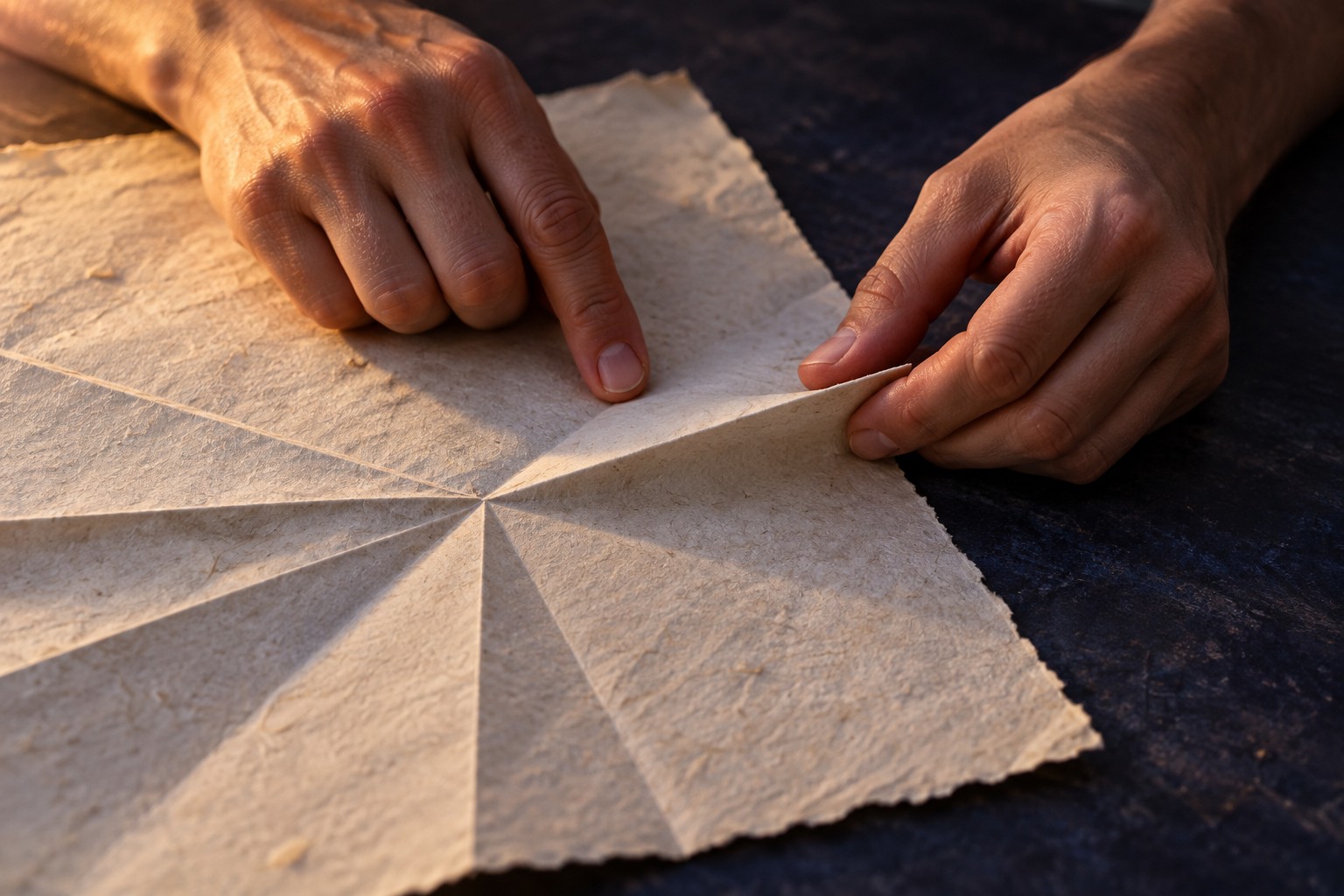
The Conscious Fold — a deliberate, embodied shift through attention, valuation, or action that shapes what becomes possible next and lets the wider field respond.
It can interrupt an old reflex or sustain something worth carrying forward: a boundary kept, a commitment renewed, a piece of work patiently continued.
In creative work, perfectionism freezes you; you make one imperfect mark and let it stand long enough for play to return. An image or phrase appears that control could not have forced.
In spiritual practice, self-judgement rises and the throat tightens around it; you notice the clench without obeying it. The session shifts from performance back to observation.
Because folds are local but relational, their effects can travel: your pause can invite another’s pause; your repair can make space for theirs. This is one way novelty enters the world through embodied, well-timed choice.
One fold opens the route; repeated folds make the new path easier to find.
The Arrow of Becoming
At the scale of a life, the arrow of becoming can be read as an accumulating record of folds: the branching path of experience traced by situated participation.
Each time you choose differently in a familiar loop, you change the local field—and the future that can arise from it.
Reality does not merely exist; it evolves without any guarantee of ascent. You are one of the conditions through which that evolution takes local form.
Embracing Emergence
Agency grows by tending conditions rather than demanding certainty.
The Dragon’s discipline here is reading the threshold where structure meets possibility: too much order ossifies; too much chaos dissolves. At the edge, novelty can arise.
When the unpredictable arrives, the first art is contact before control: feel the tension, sense what is dissolving, and notice what is beginning to gather.
Releasing Attachment to Outcome
All forms are temporary manifestations of the Firmament’s dynamism. Rigid expectation narrows the field; receptivity makes room for what cannot yet be imagined.
A practice period or difficult piece of work may yield only irritation. Two days later, after sleep, a walk, and one honest note in the journal, the next step appears quietly and fits better than the breakthrough you were trying to force.
There is an Icelandic saying, often translated as: “Sjaldan er ein báran stök.” (“Rarely does one wave come alone.”) Emergence often arrives that way: as a shifting field where one disturbance alters the conditions for the next wave. Aligning with the web does not override probability. It changes what you notice and how you move when the waves arrive.
Trusting the Self-Organizing Process
When you feel scattered, tend basics: sleep, movement, food, one honest conversation. Let the system reorganize before you force a story. Changed conditions can allow more workable order to emerge; they can also reveal what must stop, move, or be released. Trust the tending rather than demanding an outcome.
Reflecting on the Flow
Pause. Breathe. Notice.
- Where do you resist the unpredictable nature of life’s becoming? Where do you cling to fixed structures that may be asking to dissolve?
- Recall a time when something genuinely new emerged—not from planning, but from complexity or chaos. What were the conditions that allowed this emergence?
- Where in your life would one small change of condition likely alter the whole pattern? What condition wants tending first?
Emergence remains a mystery lived through timing, conditions, and care.
The Everfolding Pattern
Life keeps creating, dissolving, and re-forming, fold after fold, with no final outcome fully known in advance. Each fold leaves conditions for the next. The tendrils of the Dark Entangled carry influences and possibilities still beyond view. These hidden conditions and latent potentials help shape what can arise. You walk the Spiral Path through this unfinished world, where every return meets changed ground.
You enter that movement through deliberate choice. A pause interrupts an old reflex. A different response changes what the next encounter inherits. The Dragon takes shape through these lived turns.
The dance does not end.
It only invites the next step.
See Denis Noble, A theory of biological relativity: no privileged level of causation, Interface Focus 2(1), 55-64 (2012); and Denis Noble, The cardiac pacemakers: A paradigm of robustness in evolutionary biology, The Journal of Physiology (2026).↩︎
James D. Watson and Francis H. C. Crick, Genetical Implications of the Structure of Deoxyribonucleic Acid, Nature 171, 964-967 (1953).↩︎
Matthew Meselson and Franklin W. Stahl, The Replication of DNA in Escherichia coli, Proceedings of the National Academy of Sciences 44(7), 671-682 (1958).↩︎