Part II
Chapter 8: Participatory Reality
Estimated reading time: 10 min
“The world is not what I think, but what I live through.”
— Maurice Merleau-Ponty1
The Field in Motion
Participatory Reality begins with a harder claim than “you influence the field”: you never meet reality raw. Awareness, perception, and embodied state shape what becomes legible, felt, and actionable, without granting control over outcomes.
Awareness is not a silent guest in experience. It selects, weights, and brings a world into focus.
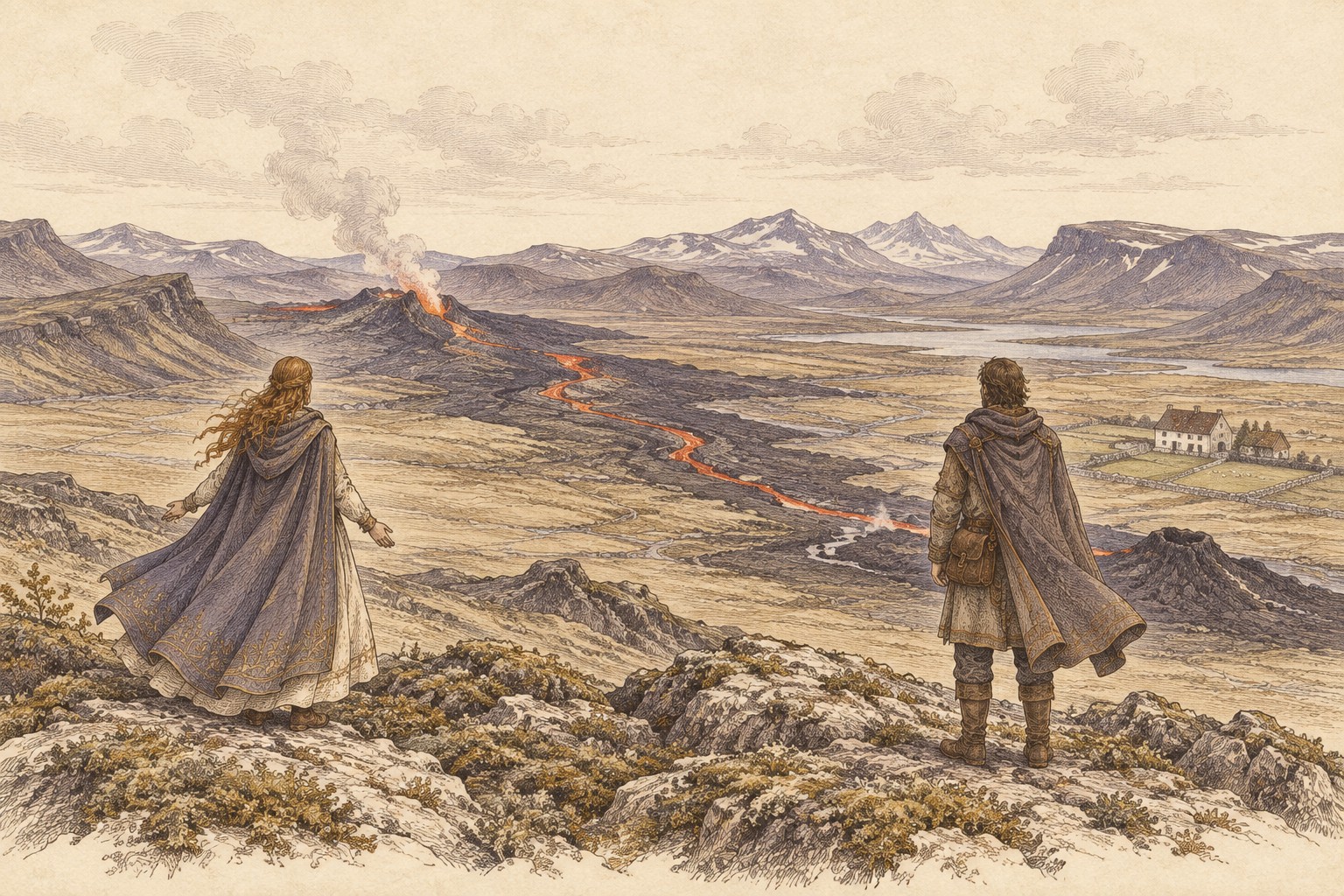
Picture a volcanic eruption: molten lava surging across black rock.
From a distant ridge, one person watches new land forming. Beside them, someone whose home lies below sees a familiar valley vanishing. Both watch the same red seam; memory and attachment give it different weight.
The lava follows the slope. Attention follows what matters, bringing one part of the scene forward while another recedes.
Here, the Dragon represents lucid participation: awareness that can notice how perception is shaping the world it is about to act from.
Perception already participates in the field it meets.
Defining Participatory Reality
Contact arrives. Attention gives it weight. Expectation adds tone. Memory, belief, and embodied state help determine what registers as threat, invitation, possibility, or noise.
You do not invent reality from nothing. You meet it through a living interface that is already selecting, filtering, and giving significance before deliberate action begins. What you perceive helps shape what becomes salient and actionable for you, and therefore what kinds of consequences you are likely to meet.
Participation starts there.
As perception sorts the field, one cue brightens while another recedes; a face may register as safe, uncertain, or dangerous, and one possibility can become visible while another slips from view.
You remain a distinct node within the network you affect. Participation means holding both: a particular life, and the whole field moving through it.
Awareness can also notice its own participation. A reaction begins, attention catches it, and the next response becomes less automatic. The field has not become yours to command; another move has simply become available.
Participatory Reality in Daily Life
A short message arrives: Can we talk? Your chest tightens before you reach the question mark. Memory, expectation, and bodily state rush in so fast the message already seems to mean more than it has said.
As the body contracts, accusation can become the brightest reading and defence can prepare before evidence is gathered. An exhale, the chair beneath you, the weight of the phone in your hand—if the system settles, uncertainty, awkwardness, grief, or simple misfire can return to view beside accusation. The message has not changed.
Regulation cannot tell you what the sender meant or prove that the situation is safe. It gives context, evidence, and choice more room to enter. Participatory Reality names that mechanism in miniature: perception shapes resonance, resonance shapes action, and repeated action either hardens or loosens the reality you are already inhabiting.
The exchange can also change the expectations you bring to the next one. What you learn about the sender shapes what you notice, anticipate, and ask when the phone lights up again.
Participation follows a plain rhythm: you meet the field, feel its resonance in body and meaning, and answer with one coherent, proportionate move. This is a loop that is already turning dozens of times each day. Awareness participates in that loop as one of the instruments through which the field becomes salient and legible.
Scientific Resonances
Different scientific methods ask related questions about contact, context, and what becomes legible.
Measurement and the Observer
What measurement means in quantum mechanics remains one of the genuinely unresolved questions in the philosophy of physics.
In quantum experiments, measurement is an interaction. The setup specifies what question is being asked, and the interaction is not neutral. Interpretations vary, and one consistent point is this: the measurement context shapes what gets recorded and what becomes legible within the experiment.
Change the apparatus and the experiment yields a different face: an interference pattern in one setup, a path-specific result in another.
In lived terms, participation does not create the signal; it shapes how the signal is received, what becomes legible, and which responses become available.
As a nervous system moves from acute threat response towards greater regulation, perception re-sorts. More context and evidence can register. The world may be unchanged; the angle of entry is not.
Expectation and the Body
The placebo effect reveals how belief and meaning can shape physiology: expectation and context can produce measurable shifts even when the substance itself is inert.
A trusted context can soften pain enough to change what a body can do in a day; a threatening one can tighten the same body without an active substance doing the work.
Belief does not command reality. The perceiver’s state colours physiology, salience, and the world that becomes possible to inhabit.
Perception and the Story-Making Mind
Perception may be tuned less for objective truth than for survival. In Donald Hoffman’s interface theory,2 the senses are modelled less as a transparent window onto the underlying real than as a sparse set of action-relevant signs.
Reality exceeds the interface. The order beneath perception remains real—more extensive, and perhaps different in kind, than what the senses and mind can gather. Evolution may favour perceptual strategies tuned to fitness over exhaustive fidelity. An icon does not reveal the circuitry beneath it; it offers a workable handle. Perception may do something similar: present a simplified, fitness-shaped rendering that helps an organism orient, choose, and survive.
Adaptive distortion is not the same as flattering self-deception. Useful misbeliefs may exist, but it is easy to overstate how much comforting distortion helps us. What perception seems built to preserve is workable contact, not comforting fantasy.
The metaphysical meaning remains open. A survival-shaped interface may point beyond ordinary perception toward structures we cannot directly see, while awe, revelation, and religious feeling may also arise through evolved perceptual systems. The lens does not settle that question.
The interface is only the first layer. Once perception has selected and weighted what matters, the mind still has to make a story from what arrives.
Split-brain research suggests how typically language-dominant left-hemisphere systems can construct coherent explanations for actions they did not fully register, laying narrative over partial information to fill the gaps. Gazzaniga’s interpreter phenomenon gives one name to this story-stitching tendency.
A body tightens, a cue brightens, and a story begins to form. By the time conscious explanation arrives, the world can already feel decided.
The danger appears when a partial rendering hardens into certainty before the wider field has been allowed to answer.
Different nervous systems can therefore stand in the same room and inhabit different lived worlds. Perception selects, filters, and weights what becomes available to experience; interpretation then gathers that partial field into a story coherent enough to act from.
Humility begins here. My view is never the whole field; yours is never neutral either. Disagreement may reveal different nervous systems and different acts of interpretation before it reveals bad faith.
The Observer’s Dialogue: Einstein & Tagore
Einstein and Tagore3 bring that tension into view. One side asks what remains true without us. The other asks what truth becomes once it passes through consciousness, relation, and the body that has to live it.
Einstein argued for a reality existing independently of human observation, governed by objective laws.
“I cannot prove, but I believe in the Pythagorean argument, that the truth is independent of human beings.”
For Einstein, reality did not wait upon the human gaze to remain real. The moon does not need a witness to keep crossing the sky; truth, for him, cannot depend entirely on the mind that sees it.
Tagore countered from the other side: the world human beings know is always mediated by consciousness, reason, feeling, and relation. Truth and beauty, for him, become available through the mind that participates in them; whatever reality may be in itself, the truth we live is never untouched by consciousness and relation.
Their dialogue anchors the paradox: reality exceeds any particular observer, yet lived truth appears through consciousness and relation. The Dragon holds both at once: a world that exceeds us, and a lived reality always shaped by how awareness meets it.
That tension does not end with science or philosophy. Older languages have stayed with it longer. Consciousness does not simply record the world it lives in.
A reaction begins. Attention catches the bias already weighting the scene. For a moment, awareness is observing the leaning that was about to become the act. That shift is a Conscious Fold. It arises inside the pattern, in time for a different turn. The lava still follows the slope. Another response has become available.
Spiritual Parallels: Intention, Illusion, and Inner Worlds
Maya: The Mind-Woven World
Return to the ridge. One person sees land being born. The other sees a valley being taken. The eruption is one event. What each is about to do belongs to a world already woven by memory, attachment, and what the moment has been allowed to mean.
Across Hindu traditions, Maya carries different meanings—creative power, appearance, concealment, or misperception—depending on the school. It cannot be reduced to the claim that separateness is illusory. The discipline that matters here is narrower. The woven world is real enough to act from, and it is not the whole slope.
Some Buddhist teachings come to a neighbouring seam through dependent origination. The valley’s meaning does not arise alone. It depends on the house, the history, the body that braced, the story already running. Change one of those conditions and the world that shows up is not the same world. A dreamlike quality does not make the lava unreal. It means the lived eruption is conditioned, and therefore not finished. That is a comparison, not the same doctrine as Maya.
Schopenhauer named this without the myth. The world we know is “my representation”: what appears as outer is shaped by the mind that beholds it, and cannot be peeled free of that beholding. The fold is the moment the representation includes itself. You notice that this is how the valley is appearing to you. The appearance continues. It no longer has to be the whole of what you do.
Perception orients. It does not give the ground entire. The map may help us walk. It is still not the ground beneath us.
Intention’s Pulse: Orienting Participation
Focused will matters because intention organizes perception, posture, and response.
Beliefs, emotions, and habits of attention shape what stands out, what feels possible, and which threads you reinforce with action.
A room looks different when attention has been trained to search for threat, beauty, exit, or opening.
Intention is not force. It is orientation: inner clarity shaping how you meet the world, kept in proportion whenever it touches another life.
Hermetic Insight: As Above, So Below
The Hermetic maxim “As Above, So Below” names correspondence across scales. “As Within, So Without” is a later expansion, used here as a relational analogy rather than as part of one ancient axiom.
The two on the ridge are already inside that narrower question. As attention, expectation, and body state change, the same eruption presents different edges: attention steadies, different features come forward, and different actions become available. The maxim does not decide which edge. The state does.
Discipline turns attention into a craft: skilful perception, pattern literacy, and ethical influence rather than command over reality. The colouring becomes visible before it is mistaken for the whole. Lucid participation meets the world without pretending to command what exceeds it.
Living Participation
Participatory Reality becomes useful when perception is already moving and you still have a choice about what follows.
What am I noticing first? What might my body, history, or expectation be adding? What does this moment require me to see more clearly before I act?
You do not need perfect perception before acting. You need enough humility to know that your first reading is partial, enough contact to notice what is shaping it, and enough agency to choose a response you can stand behind.
Perception has already begun.
The next move is yours to choose, and yours to answer for.
Maurice Merleau-Ponty, Phenomenology of Perception, translated by Colin Smith (first English edition 1962; Taylor & Francis e-Library edition, 2005), Preface, p. xv.↩︎
For a concise statement of the interface view, see Donald D. Hoffman, The Interface Theory of Perception (2016), and Donald D. Hoffman, Manish Singh, and Chetan Prakash, The Interface Theory of Perception (2015).↩︎
For a widely circulated text of the July 14, 1930 dialogue, later published in Modern Review (January 1931), see The Nature of Reality.↩︎