The Iterated Self: You Are a Function, Not a Constant
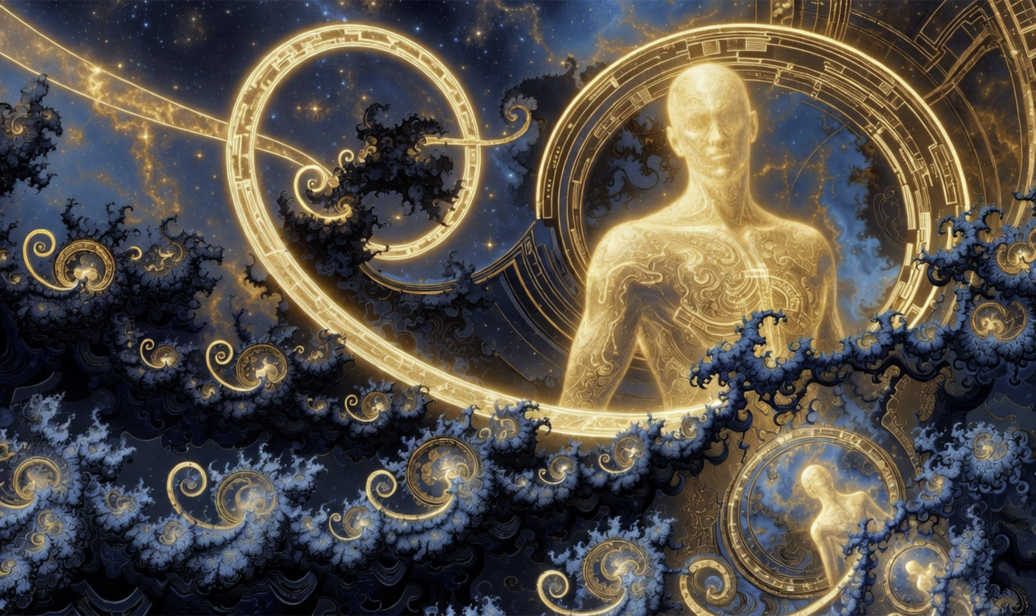
You Are a Function, Not a Constant
We tend to view our lives as a trajectory—a line moving from birth to death. We treat “Self” as a noun: a fixed object traveling through time.
But then a familiar trigger lands. Someone you love says one sentence in the wrong tone. Your chest tightens. Your mind snaps into its old position. You defend, or disappear, or strike first. Later you tell yourself, Next time I’ll stay open. Then the next time arrives, and the same sequence runs.
The same input lands. The same subroutine executes. The same output emerges.
A linear model doesn’t explain that. Feedback loops explain that.
You are not a line. You are a loop.
In cybernetics—the study of control and communication in animals and machines—you are not best understood as an object. You are a pattern with update rules.
But on this path, recursion is never just abstract. It cashes out in a body: in physiology, relationship, and consequence.
I’m using this cybernetic lens on purpose in this post. One useful move here is isomorphism: the same shapes repeating across domains that look unrelated—psyche and relationship, biology and myth, mathematics and spirit. When you can see the shared structure, you get another handle on change.
Most people stay stuck because they try to change their reality (the Output) by manipulating their circumstances (the Input), while treating themselves (the Function) as fixed.
A more useful view is this: your patterns can be updated.
Here is the math of your becoming.
The Equation: Sn + 1 = P(Sn)
Let’s map the basic unit of human experience: the recursive update loop.
Sn + 1 = P(Sn)
- Sn is your Current State (sensory inputs, biochemical baseline, environmental variables).
- P is The Processor (you—your heuristics, weights, biases, and compiled subroutines).
- Sn + 1 is the Next State (your reaction, your decision, your output).
The output of this moment (Sn + 1) immediately becomes the input (Sn) for the next iteration.
The tragedy of the unexamined life is that we treat P as Read-Only.
We say: “I am an anxious person.” Cybernetic translation: The function P contains a high-gain feedback loop on threat-detection variables.
When we treat P as a constant, our only strategy for optimization is to control Sn. We try to curate a perfect life with zero noise, zero friction, and perfect inputs. We try to sanitize the dataset.
But the Entangled Firmament, the participatory field of reality we live in, is a chaotic system. You cannot control Sn forever.
If P is unchanged, the system converges on the same attractor every time.
The Insight: P Is Mutable
The central revelation of the Magician archetype is that P is not destiny. It can be revised through repeated updates under lived conditions.
This is the function of the Conscious Fold: it is not just a choice; it is a meta-function that updates the processor itself.
The equation of transformation looks like this:
Pn + 1 = Update(Pn, Observation, Choice)
This is Second-Order Change.
- First-order change: adjusting variables within the system (trying harder, running the loop faster).
- Second-order change: changing the rules of the system (rewriting the conditional logic).
Here the Serene Center functions less like mysticism and more like a runtime pause: a moment where the loop is visible before it executes. You are no longer identical with the script that was about to run. You can inspect it, make a Conscious Fold, and let the next turn land differently.
The Stability Trap: Homeostasis & Negative Feedback
If refactoring is possible, why is it so hard? Why does the system revert to the old P even after we decide to change?
It’s not because you are broken. It’s because you are optimized for stability.
A control system is designed to minimize error and keep internal variables within bounds—to keep entropy from running away.
In control theory, stable systems rely on negative feedback loops. If a variable deviates from the set point, the system applies a restoring force (damping) to bring it back.
- Set point: your familiar baseline (even if it’s miserable).
- Deviation: your attempt to change (new behavior, new identity, new constraints).
- Restoring force: doubt, fatigue, “self-sabotage,” a sudden urge to retreat.
To a cybernetic system, change = error.
When you try to update P, homeostatic regulators detect a deviation from the historical baseline. They send error signals to push the system back toward the known state.
This is hysteresis: the state of a system depends on its history. The system has memory, and that memory behaves like inertia.
Often you are not fighting demons so much as damping: history, homeostasis, and a body trying to return to what it knows. You are trying to push the system out of a deep attractor basin. To escape, you need enough activation energy to overcome the restoring force of your own baseline.
The Debugging Protocol: A 4-Step Loop
How do you change a pattern while you are still inside it—without waiting for a calm week and perfect conditions? You run a short loop you can repeat in the moment.
1. Interrupt the Loop (Make Space)
When the inputs trigger the old subroutine (for example: conflict → defense), pause. This corresponds to the Somatic Triad: Exhale, Orient, Sense.
The gap is the whole point. It buys you enough space to choose, instead of simply executing.
2. Reverse Engineer (Name What It’s Protecting)
Look at the logic that was about to run, as if you were reading a log file.
- Legacy script: If uncertainty, then control.
Don’t judge it. It was written for a previous context. Just name it: “Ah. That’s my protection script.”
3. Write the Patch (Choose One New Move)
Now choose one alternative you can actually run once.
- Patch: If uncertainty, then curiosity.
You don’t need to delete the old script. You just need a conditional override for this specific iteration.
4. Run It (Let Reality Teach You)
This is where most systems fail.
You cannot just think the patch. You must run it in real life.
Stand in the uncertainty and execute the curiosity instead of the control.
This honors computational irreducibility: you cannot simulate the outcome in a vacuum. You have to generate a new Sn + 1 to update the system’s weights. The system learns from lived data, not theory.
The Gödel Limit: Why You Cannot “Solve” the System
There is one final constraint in the architecture.
You might be tempted to think: “If I just refactor P enough—if I optimize every subroutine—I will finally be a closed, perfect, self-consistent system.”
Mathematics says no.
Gödel’s incompleteness theorems are about formal provability inside axiomatic systems. Used here as a metaphor—not a literal proof about minds—they point to a simple limit: in any sufficiently rich formal system, there are true statements that cannot be proven from within the system’s own axioms.
You are a complex system. This means you cannot fully “solve” yourself using only your own current assumptions. Some remainder will always slip past the model.
- You cannot reason your way out of every feeling.
- You cannot prove your way out of every mystery.
- You cannot optimize your way out of the Void.
There will always be a remainder in your inner life—something you cannot settle from the inside.
In Dragon language, we call this the Void: the open variable that keeps the system from suffocating, the silence between iterations.
If you try to close the loop completely—to become a perfect, self-consistent machine—you build a prison (the Iron Grip).
The goal of refactoring P is not to eliminate mystery. It is to build a system robust enough to dance with it.
Iteration Is the Goal, Not Perfection
In software, version 1.0 is never perfect. It just crashes less than the beta.
The Law of Integration states: What is reinforced is what is integrated.
Every time you successfully run the new P, the probability of running it next time increases. The weight of that neural edge gets heavier.
This is how Fractal Resonance begins: coherence introduced in one small loop can start to echo into the next octave of your life.
You are not a noun. You are a verb. You are a process learning itself in real time.
Stop trying to be a “better person” (a fixed ideal).
Start reinforcing better loops.
The error log is not a judgment. It’s data for the next update.
Run the loop.
Where to Go from Here
- Primary next step (today): write down one live loop
in plain language:
if X, then I do Y. Then design one override small enough to run once today. If you need a body interrupt first, use the Somatic Triad from Chapter 1. - If you keep snapping back to baseline: assume damping is working as designed. Reduce step size, reduce gain, and repeat until the new output becomes the new input.
- Go deeper (pick one): Chapter 10: Graphs of Reality (loops and irreducibility), Chapter 11 (Gödel as metaphor), or The Source Code of the Soul (archetypes as mechanics).
- More book anchors (optional): Chapter 7 (recursion as emergence), Chapter 23 (the “hardware”), Chapter 44 (Fractal Resonance as a lived synthesis).
- Recent echoes beyond the book: A few weeks after this post, two public examples pushed the same question from another angle: EON’s Embodied Brain Emulation and New Scientist’s Human Brain Cells on a Chip Learned to Play Doom in a Week. They are not proof of this frame, but they do sharpen the same question: what changes when pattern, feedback, learning, and embodiment are coupled?
- Reflection: What is your most reliable “if X, then Y” clause—and what is the smallest patch you can run once today?
- If you want to stay connected: Contact or follow new posts via RSS.